
Transforming a motorcycle into a sidecar requires thinking in terms of a technical ensemble, not as an added accessory. Each motorcycle-sidecar combination forms a distinct vehicle in the eyes of the administration, with its own constraints regarding mass, geometry, and homologation. Before choosing a kit or a workshop, three parameters determine the success of the project: the rigidity of the original frame, the balance of masses once the sidecar is attached, and the consistency between the initial assembly and long-term maintenance.
Frame Rigidity and Anchor Points: What Determines Feasibility
The first technical filter is neither power nor engine displacement, but the frame’s ability to withstand lateral forces it was never designed to endure. A steel trellis frame absorbs asymmetric forces better than a perimeter aluminum frame, which is more rigid in torsion but less tolerant to shear forces exerted by the mounting arms.
The anchor points of the sidecar are generally bolted onto the main frame, the swingarm, and sometimes the engine. If the motorcycle does not have sufficiently thick or reinforced mounting areas, plates must be welded, which alters the load-bearing structure and can pose a problem during homologation.
| Criterion | Steel Trellis Frame | Aluminum Perimeter Frame |
|---|---|---|
| Tolerance to Lateral Forces | Good (controlled flexibility) | Poor (risk of cracking at welds) |
| Ease of Mounting Arms | Bolting points often accessible | Frequently requires added plates |
| Structural Modification Required | Rarely necessary | Often necessary |
| Impact on Homologation | Limited if original points are retained | Potentially blocking if welds on load-bearing frame |
This table highlights a point that general guides overlook: the choice of the base motorcycle is not made from a catalog, but by physically inspecting the chassis. Those who want to transform a motorcycle into a modern sidecar save time by immediately ruling out sporty aluminum frames in favor of road platforms with steel frames.
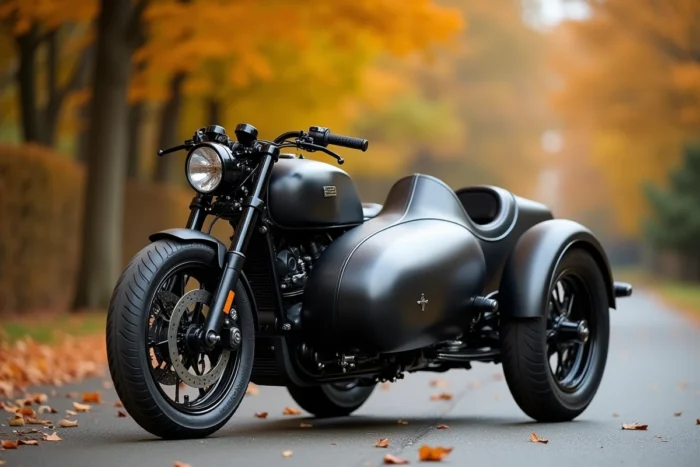
Mass Balance and Steering Geometry of a Sidecar
Once the sidecar is mounted, the motorcycle no longer behaves like a two-wheeler at all. The center of gravity shifts laterally, and the steering becomes asymmetrical: turning towards the sidecar requires different effort than turning in the opposite direction.
Trail Offset and Fork Angle
Most sidecar kits provide for adjusting the trail offset to compensate for lateral traction. Without this adjustment, the motorcycle constantly pulls towards the sidecar, which fatigues the rider and prematurely wears out the steering bearings.
The trail offset must be specifically adjusted for each motorcycle-sidecar combination. A generic adjustment, even from the kit manufacturer, does not take into account the actual weight of the loaded sidecar or the exact position of the anchor points on the chosen frame.
Weight Distribution and Cornering Behavior
The empty sidecar does not weigh the same as the sidecar occupied by a passenger or cargo. This variation significantly alters cornering behavior.
- Right-side sidecar (standard configuration in France): left turns lift the sidecar, which can cause the side wheel to lift off the ground if the speed is too high.
- Loaded sidecar: the risk of lifting decreases, but braking becomes longer and the traction of the rear wheel changes.
- Empty sidecar downhill: lateral imbalance increases, requiring heightened vigilance on braking and trajectory.
An overly heavy or unbalanced sidecar directly affects maneuverability and safety over long distances. Recent field reports confirm that reliability issues during travel more often stem from poor mass distribution adjustments than from mechanical defects.
Sidecar Homologation in France: A Procedure by Combination
In France, homologation is specific to each motorcycle-sidecar combination. Owning a homologated motorcycle in solo and a separately homologated sidecar kit is not enough: the whole must be validated as a unique vehicle.
The procedure goes through the DREAL of the region where the vehicle is registered. Requirements vary from one DREAL to another, creating disparities in the interpretation of texts. An assembly accepted in one region may be refused in another for documentation or measurement reasons.
Technical Inspection and Long-Term Monitoring
Since the extension of technical inspection to motorcycles over 125 cm3, transforming into a sidecar also requires planning for ongoing compliance. An assembly acceptable at the time of homologation may be called into question if adjustments drift or if worn parts are not replaced.
This point changes the logic of the project: it is no longer just about mounting a sidecar, but about maintaining consistency between homologation, maintenance, and actual use throughout the vehicle’s lifespan. Planning specialized workshop follow-up from the start avoids unpleasant surprises during inspection.
Choosing a Sidecar Kit: Technical Parameters to Compare
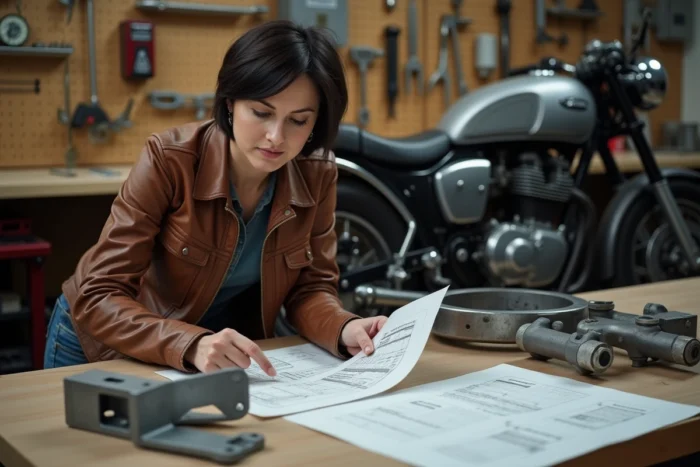
Sidecar kits differ on three axes: the mounting system (rigid or articulated arms), the type of sidecar (open, closed, cargo), and compatibility with the targeted motorcycle frame.
- Rigid arms: simpler to install, they transmit more vibrations to the sidecar and frame. Suitable for urban use and short trips.
- Articulated arms: they better absorb dynamic stresses, but their adjustment requires more precision and regular maintenance of the joints.
- Cargo sidecar: heavier than passenger sidecars, it lowers the center of gravity, stabilizing the whole but increasing the load on the anchor points.
A kit that is compatible on paper may prove unsuitable once mounted if the actual dimensions of the frame differ from the catalog specifications. Measuring the mounting distances before purchase remains the only reliable method.
The modern sidecar market offers sidecars made of fiberglass or aluminum, with independent suspension systems. These recent sidecars provide better road behavior than older steel models, but their price reflects this technical difference.
Transforming a motorcycle into a sidecar is not just about bolting on a sidecar. The frame, steering geometry, mass distribution, and administrative follow-up form an interdependent system. Neglecting any one of these parameters weakens the whole, whether on the road or in front of the administration.