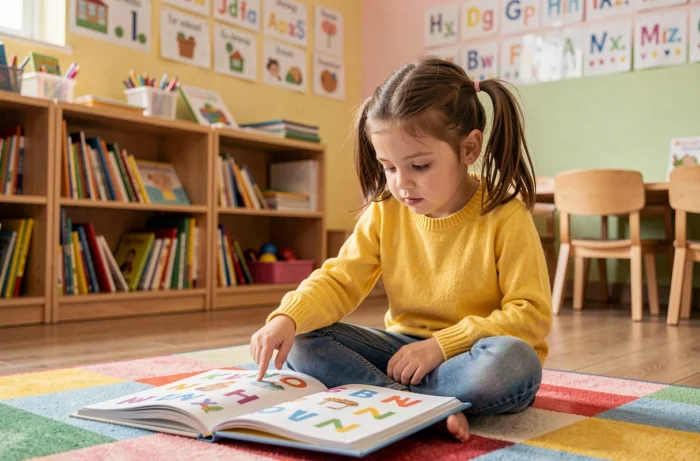
The kindergarten programs applicable from the start of the 2025 school year more clearly distinguish between oral language learning and those related to entering written language. This evolution changes the role of the final year of kindergarten in the path toward reading: it is no longer just a waiting room for first grade, but a moment where specific skills are developed, the impact of which research now measures on the continuation of schooling.
Alphabetic principle in the final year of kindergarten: what recent data shows
A study conducted by the University of Aix-Marseille, CNRS, and the École Normale Supérieure, reported by Le Monde in September 2026, established that mastery of the alphabetic principle upon entering first grade is a predictive indicator of later reading progress. Children who understood this principle read more quickly and effectively at the beginning of second grade.
The alphabetic principle is the system by which written words are composed of letters that transcribe phonemes. In the final year of kindergarten, the goal is not yet to read fluently, but to grasp this correspondence between oral and written language. It is this understanding that differentiates a prepared child from one who deciphers through visual memorization.
To structure the learning of reading in the final year of kindergarten, teachers rely on activities involving the encoding of simple words, where the child must find the letters corresponding to the sounds they hear. This active approach anchors the alphabetic principle more firmly than mere recitation of the alphabet.
Phonological awareness: the foundational skill before decoding
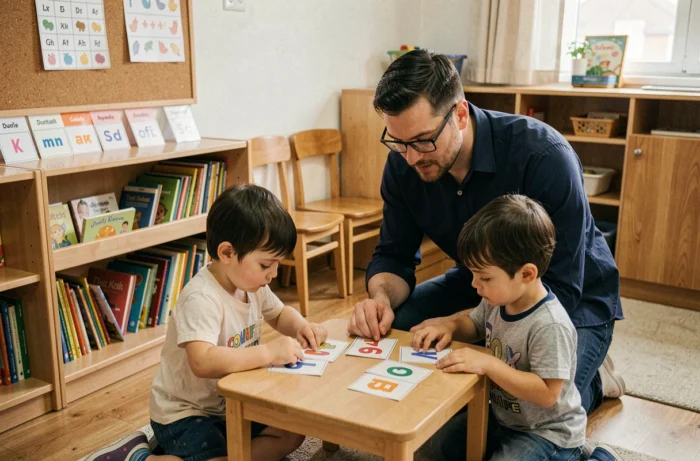
Phonological awareness refers to the ability to perceive and manipulate the sound units of a word: syllables first, then phonemes. The guide from the Ministry of National Education for preparing reading instruction places it at the center of kindergarten activities.
Specifically, a child in the final year of kindergarten first learns to segment a word into syllables (pa-pi-llon), then to isolate a sound at the beginning or end of a word. This progression is not trivial: rushing too quickly to phonemes without mastering syllables leads to confusion.
The most documented exercises rely on oral manipulation:
- Clapping the syllables of a word by clapping hands, then counting the number of claps for each proposed word.
- Sorting images according to the initial sound (all words starting with the sound /m/ in one basket, the others in a second).
- Removing a syllable from a known word and guessing what remains (“chapeau” without “cha” gives “peau”).
These phonological games are initially practiced without written support. Writing then comes into play when the child associates the identified sound orally with the corresponding letter or group of letters (the grapheme).
Syllabic method in the final year of kindergarten: how far to go without anticipating first grade
The syllabic method structures learning around the association of letters and sounds. In the final year of kindergarten, it does not aim for reading complete sentences but the acquisition of a repertoire of grapheme-phoneme correspondences sufficient for the child to begin decoding simple syllables (la, mi, to).
Field feedback diverges on the pace to adopt. Some teachers introduce about ten correspondences during the year, while others go up to twenty. The new programs of 2025 reinforce gradual progression without setting a specific numerical threshold, allowing for adaptation based on the level of each class.
One point is more widely agreed upon: coupling reading and writing accelerates the memorization of correspondences. When a child writes the syllable “ma” after reading it, they engage both the graphic gesture and sound decoding. The ministerial guide emphasizes this link between reading and writing from kindergarten.
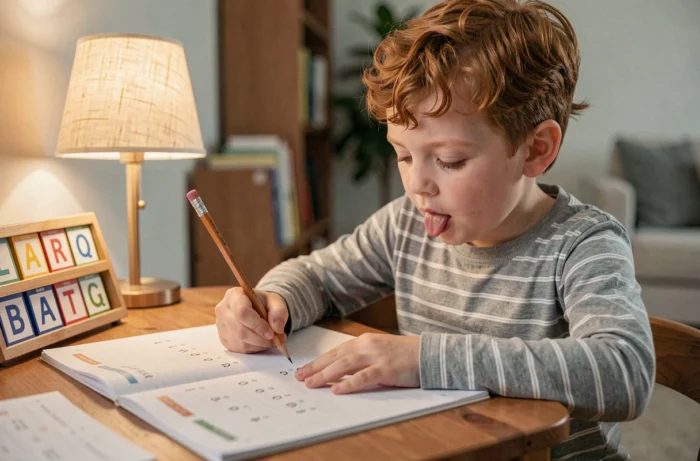
However, recent research does not demonstrate that very early formal reading instruction is superior to structured preparation. The lack of large controlled experiments comparing starting at four or five years with starting at six invites caution. Preparing for reading is not the same as teaching fluent reading.
Reading activities and games at home: what works in addition to school
Activities practiced at home can extend schoolwork, provided they respect the same progressive logic. A few simple principles emerge from the recommendations of the ministerial guide and feedback from teachers:
- Read aloud every day while pointing to the words: the child integrates the sense of reading (left-right) and begins to recognize recurring words.
- Play with everyday sounds: look together for all the kitchen objects that start with the sound /p/, for example.
- Offer movable letters (magnetic, wooden) for the child to compose syllables or short words dictated orally.
- Avoid overly academic exercise books that turn the moment into a constraint: manipulation and play remain the most effective levers at this age.
The goal is not to produce an independent reader before first grade. It is to build a solid enough foundation of phonological and alphabetic skills so that decoding in first grade relies on stable foundations. A child entering first grade knowing how to segment sounds and recognize about fifteen letter-sounds has a measurable advantage, as confirmed by the data from the Aix-Marseille/CNRS/ENS study.
The final year of kindergarten remains a transitional space. The methods that work best are those that articulate oral and written language, manipulation and repetition, without trying to rush the steps.