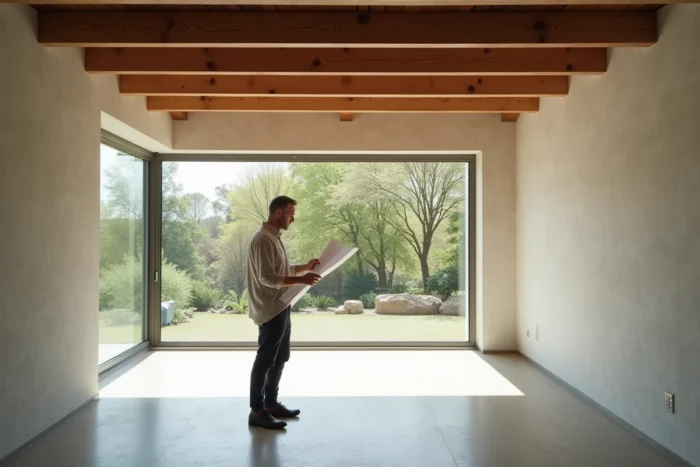
A basement with its upper half above ground level, featuring windows that let in daylight: this is what distinguishes a semi-buried basement from a traditional cellar. This configuration, common on sloped lots, offers a potential for development that many homeowners underestimate, due to a lack of understanding of the technical constraints that accompany it.
Moisture Diagnosis Before Any Development Project
Before considering decoration or partitioning, the first step is to identify the exact source of the moisture present in the basement. Three distinct mechanisms can coexist, each requiring a different treatment.
Condensation occurs when warm air from the house comes into contact with cold walls. Capillary rise, on the other hand, causes water to rise from the ground through the masonry by absorption. Lateral infiltrations come from the pressure of the groundwater against the buried walls.
Do you see damp spots on your basement walls but don’t know where they come from? A simple test can clarify: attach a sheet of aluminum foil to the wall for 24 hours. If moisture appears on the wall side, the problem originates from the structure. If it forms on the room side, it’s condensation.
Measuring humidity at different heights on the wall also helps distinguish capillary rise (more humid at the bottom) from infiltrations (localized humidity at mid-height or the top). Ventilation alone does not solve anything if the water comes from the structure: then you will need to consider peripheral drainage or waterproofing depending on the building’s external accessibility.
The characteristics of a semi-buried basement make this diagnosis more nuanced than in a fully buried cellar, as the above-ground part and the buried part do not react the same way to water.
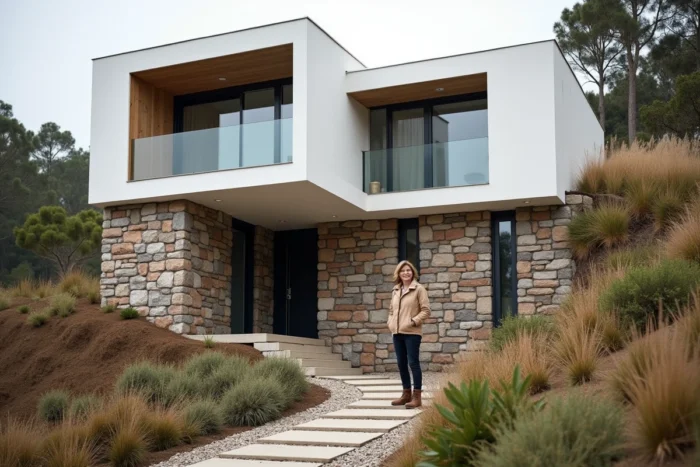
Thermal Insulation of a Semi-Buried Basement: Two Zones, Two Approaches
The uniqueness of the semi-buried basement lies in its dual exposure. The buried part is in direct contact with the ground, while the emerging part behaves like a classic exterior wall, exposed to temperature variations and wind.
Buried Walls: Priority on Waterproofing
For walls in contact with the earth, interior insulation remains the most common solution. The choice of insulating material must take into account the humid environment. Extruded polystyrene or polyurethane panels resist moisture well, unlike traditional mineral wool, which loses its thermal properties upon contact with water.
Installing insulation without addressing moisture beforehand is akin to masking the problem. Water trapped between the wall and the insulation causes mold and accelerated degradation of materials.
Above-Ground Walls: Classic Insulation Logic
The emerging part of the basement can be insulated from the outside if the budget allows, or from the inside with standard materials. This area has an advantage: the windows allow for natural ventilation that limits condensation.
A often overlooked point concerns the basement ceiling. If the space is not heated, insulating the ceiling protects the living spaces above and reduces thermal losses downward. According to ADEME, a poorly insulated basement can let up to 10% of the home’s heat escape.
Ventilation and Natural Light: The Two Advantages of the Semi-Buried Basement
Why does the semi-buried basement appeal more than a traditional cellar? Because it allows for the installation of windows, sometimes of standard size, on the above-ground part. This natural light radically changes the potential use of the space.
Ventilation directly benefits from these openings. A simple single-flow ventilation system is often sufficient for well-exposed configurations. For a living space layout, a double-flow ventilation system combined with openings on the emerging part ensures effective air renewal while limiting heat loss.
If you plan to install a double-flow ventilation system as part of a comprehensive renovation, be aware that MaPrimeRénov’ now requires this action to be combined with at least one insulation task to benefit from it. Insulating walls as a standalone action is no longer part of the work funded by this scheme since early 2026.
- The windows of the semi-buried basement must be installed above ground level to prevent infiltration from runoff.
- Reinforced insulation glazing limits condensation on the glazed surfaces, which is common in a partially buried space.
- Light wells or enlarged vents complement natural lighting in the deepest areas.
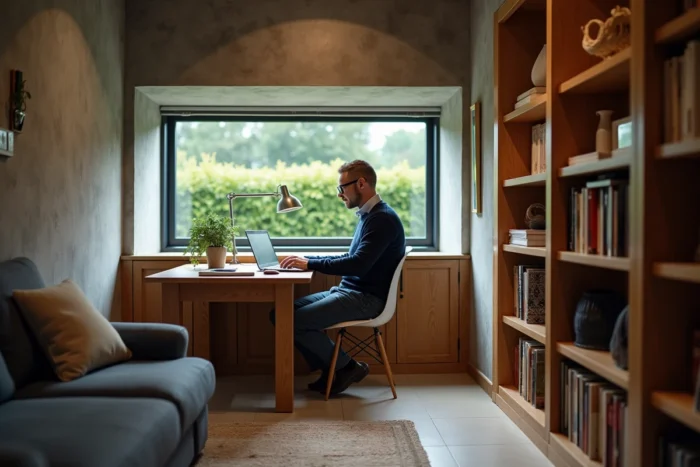
Development of the Semi-Buried Basement: What the Land Requires
The type of land largely determines the possibilities for development. A clay soil that swells with water exerts more pressure on buried walls than a sandy, draining soil. This factor influences the choice between external drainage and internal waterproofing.
The ceiling height determines the permitted uses. For a basement to be considered habitable in the regulatory sense, the minimum height and the conditions for ventilation and lighting must meet specific criteria that vary by municipality.
On a sloped lot, the semi-buried configuration offers a particularly interesting setup. One side can have a level access, transforming the basement into a true garden-level space. This arrangement simplifies access, brightness, and even evacuation in case of emergency.
- Check your municipality’s PLU before any project: some limit the floor area in the basement or impose rules on the number of levels.
- An independent external access significantly increases the versatility of the space (workshop, studio, professional room).
- Address drainage before pouring a slab: correcting a finished floor to fix a water issue costs much more than planning for it from the start.
The semi-buried basement is neither a cellar nor a classic floor. Its value entirely depends on the rigor with which moisture, insulation, and ventilation are addressed before considering development. A space well-prepared on these three technical points becomes an exploitable area at a lower cost, whereas a hasty approach generates lasting structural problems.