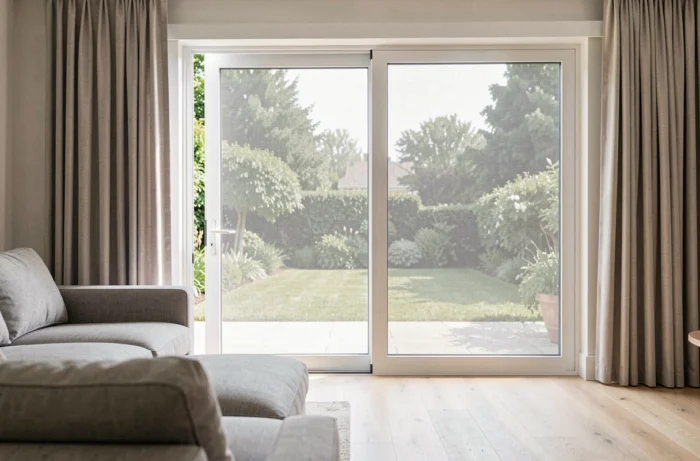
Installing a roll-up mosquito net on a sliding glass door measuring 300 x 220 cm is not just about choosing a model from a catalog. At this size, compatibility with the environment of the carpentry (roller shutter, handle, type of frame) becomes the real issue. Many field reports indicate problems with the bulk of the box or obstruction when opening, turning a logical purchase into a source of daily frustration.
Actual compatibility of a roll-up mosquito net with a 300 x 220 sliding glass door
The size 300 x 220 cm corresponds to sliding glass doors with two or three panels found in most recent constructions. On paper, a lateral roll-up mosquito net (one or two rolls) covers this area. In practice, several points need to be checked before purchase.
The first concerns the roller shutter box. On a door of this width, the box often occupies a band of several centimeters at the top. If the mosquito net box needs to be fixed under the lintel, the remaining space between the roller shutter box and the top of the opening may be insufficient to accommodate the roll-up profile.
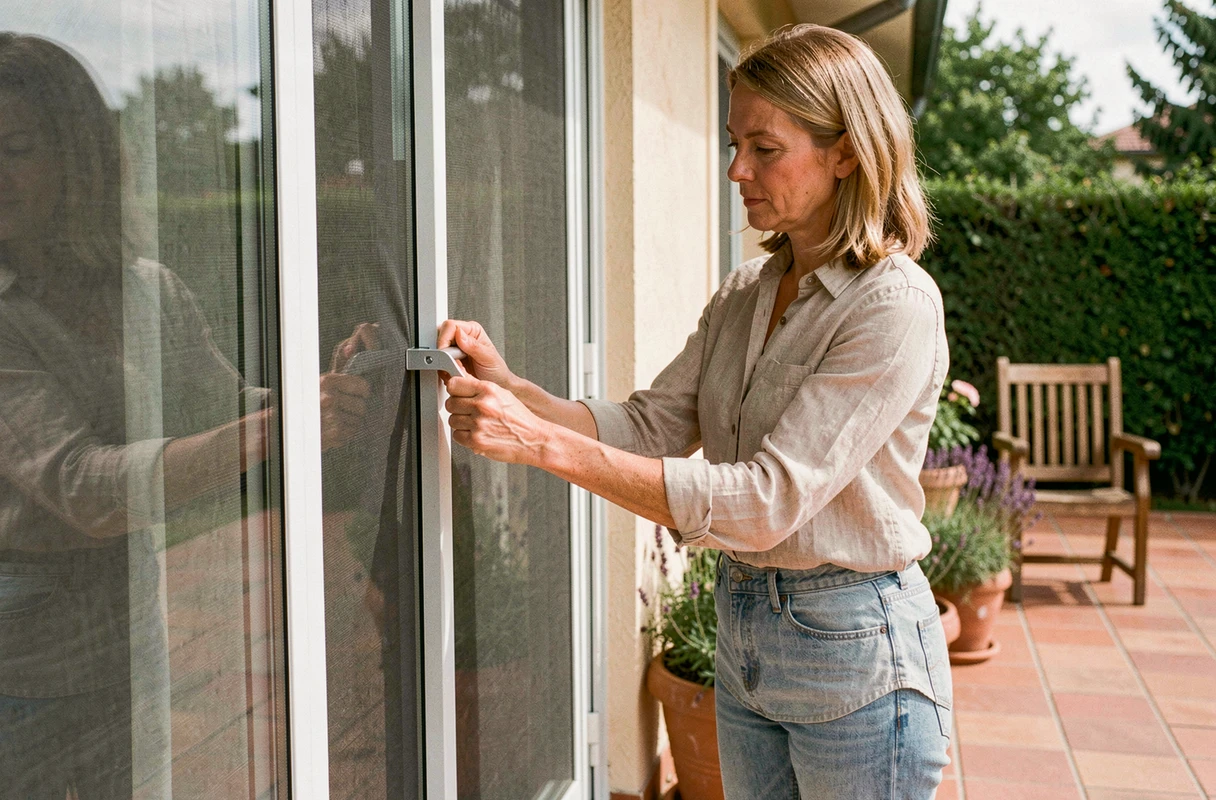
The second point concerns the handle of the door. Lateral roll-up mosquito nets move in vertical tracks fixed on either side of the opening. On a two-panel model, the central track falls exactly where the locking handle is located. A poorly positioned track prevents the door from being locked or requires the mosquito net to be removed every evening.
The third element is the bottom rail. Installation guides remind us that a guide rail on the ground is often necessary to keep the fabric taut over a width of three meters. This rail creates a slight bump at the threshold, which can hinder barefoot passage or the rolling of a chair. Field reports vary on this point: some manufacturers offer recessed rails, while others settle for a glued profile.
A complete file detailing the configurations suitable for this size is available, notably the page dedicated to the roll-up mosquito net for 300 x 220 sliding glass doors on Blog Habitat, which reviews the systems compatible with common carpentry.
Installation without drilling on sliding glass doors: marketing promise or reliable solution
Installation without drilling has become a central selling point for mosquito nets intended for renters or for recent PVC and aluminum carpentry. Several systems exist: adhesive fixation, spring clips on the frame, or adjustable tension brackets.
On a standard window, these solutions work. On a door measuring 300 x 220, the question changes scale. The fabric is heavier and experiences more wind resistance, especially if the door opens onto an exposed terrace. Double-sided adhesives, even of industrial quality, do not withstand the repeated stresses of opening and closing on a three-meter-wide profile.
Clip or tension systems offer better mechanical stability, provided the frame has a sufficient ledge to accommodate the clamp. On hinged sliding doors (French opening), the ledge generally exists. On sliding doors, the profile is smoother and the grip less pronounced.
- Adhesive fixation: suitable for small openings, risk of peeling on large formats exposed to wind
- Spring clips: good hold if the frame offers a ledge of at least a few millimeters, easy to disassemble
- Tension brackets: intermediate solution that does not drill but requires a solid upper and lower support
- Screwing into the frame: the most stable fixation for a 300 x 220 format, but irreversible on new carpentry
A well-executed drilling remains the most durable fixation for this size. For a renter, discussing with the landlord beforehand can avoid complicated disassembly at the end of the lease.
Fabric, aluminum box, and tracks: what distinguishes a durable product
The PVC-coated fiberglass mesh is the most common material for roll-up mosquito nets. It offers a good compromise between visual transparency, mechanical resistance, and protection against insects. Some manufacturers offer polyester or stainless steel fabrics, but these are rare in large format roll-up models.
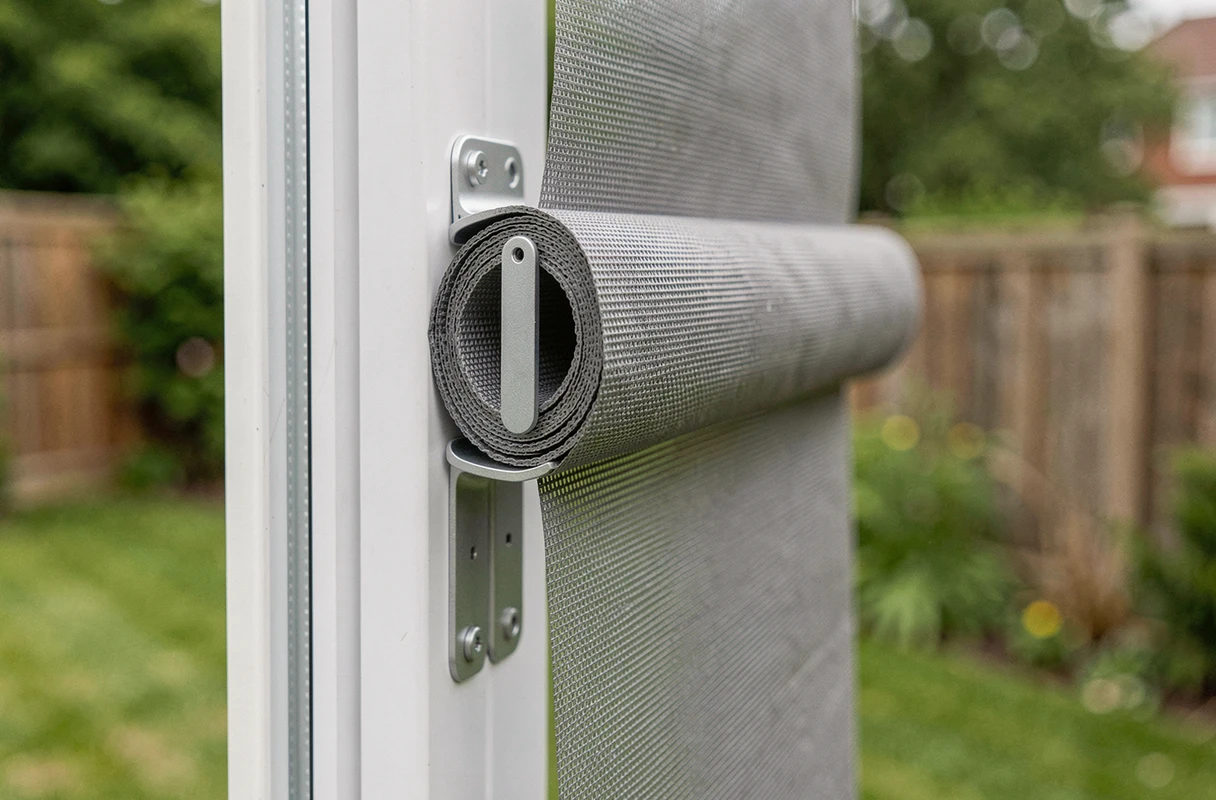
The lacquered aluminum box protects the roll-up mechanism and the folded fabric. On a three-meter format, the rigidity of the box matters: a profile that is too thin deforms under its own weight and causes asymmetric rolling. High-end models integrate a compensation spring in the roll-up tube to maintain a constant tension on the fabric.
The side tracks, equipped with brushes or soft seals, ensure insect tightness. On a large sliding glass door, tracks with wind brushes prevent the fabric from coming out of the rail during drafts. This detail, rarely highlighted in product sheets, makes the difference between a mosquito net that stays in place and a fabric that flaps at the slightest breeze.
Maintenance of the roll-up mosquito net: a neglected topic
The majority of online content focuses on model selection and installation. However, maintenance is crucial for the longevity of the product. The mesh accumulates dust, pollen, and pollution residues, especially in urban areas or near roads.
A cleaning with lukewarm soapy water, without aggressive products, is sufficient to preserve the mesh. The tracks and the bottom rail should be cleared regularly: a grain of sand stuck in the track can block the rolling and damage the fabric. The fixings (screws, clips, or adhesives) deserve an annual check, especially after a summer of intensive use.
Custom-made or cuttable: what format for a 300 x 220 door
Cuttable mosquito nets are sold in standard dimensions and can be adjusted in width and height by cutting. The price is lower than that of a custom-made product, but cutting a three-meter box requires precise tools (miter saw, not a hacksaw).
Custom-made guarantees a millimeter-perfect fit, which reduces gaps between the track and the frame. On a 300 x 220 door, a gap of a few millimeters is enough to let in mosquitoes and flies. French manufacturers offer online configurators that take into account the position of the roller shutter, the type of frame, and the presence of a handle.
The cuttable option is suitable if the door has dimensions close to a market standard and if the installer is skilled in aluminum cutting. For atypical configurations (door with transom, offset roller shutter, raised threshold), custom-made remains the only truly reliable option.
The choice between these two formats depends as much on the budget as on the exact configuration of the carpentry. Taking measurements accurately, measuring at three different heights to detect any potential misalignment of the frame, remains the step that conditions everything else.