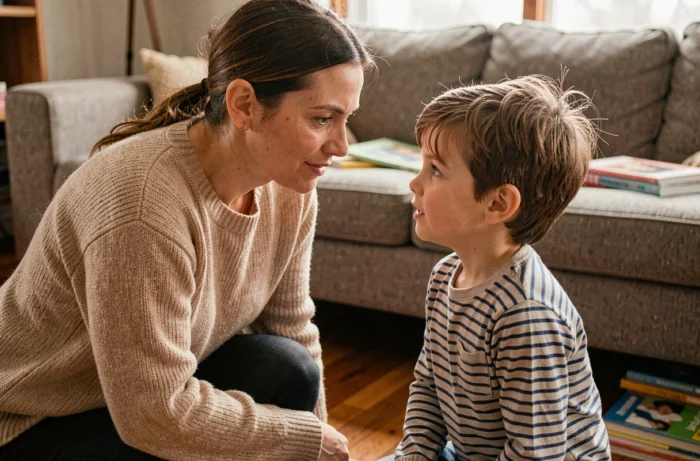
A child throwing their plate on the floor, another refusing to get dressed for twenty minutes: these morning scenes test the patience of all parents. Supporting your children daily with kindness doesn’t rely on a one-size-fits-all recipe, but on some concrete guidelines that change family dynamics. Here are the most useful levers, those that produce visible effects in just a few weeks.
Repairing after a shout: the most underestimated parental gesture
You may have noticed that articles on gentle parenting talk a lot about prevention, but rarely about what happens after an outburst? A parent shouting happens. The important question is what we do in the minutes that follow.
Childcare professionals recommend three simple steps. First, acknowledge the shout or hurtful words in front of the child. Next, offer clear apologies without minimizing. Finally, explain what triggered the reaction, so the child understands that the anger came from the parent, not from them.
This repair mechanism teaches the child that making mistakes is part of relationships. They learn that one can err and return to the other. It’s a much more powerful model than a facade of constant calm, because it concretely shows how to manage emotions afterward.
Many online resources detail approaches suitable for each age group. Notably, practical sheets on children on Maman du Quotidien address these situations from the parental perspective.

Kind boundaries and limits: what the law says about educational violence
Kindness is sometimes confused with laxity. Setting a clear framework is part of gentle support. This framework actually has a precise legal foundation.
Since the law of July 10, 2019, Article 371-1 of the Civil Code specifies that parental authority is exercised without physical or psychological violence. In concrete terms, slaps, spankings, humiliations, threats, and insults are prohibited. Parental behaviors can now weigh in decisions regarding parental authority, even without a criminal conviction.
Setting limits without resorting to violence means formulating short and understandable instructions. Saying “we don’t hit” is more effective than a long moral lecture. The child needs to know where the boundary lies, and this boundary reassures them.
Replacing punishment with logical consequences
Traditional punishment (deprivation of dessert, time-out) cuts off the relationship without teaching much. Logical consequences, on the other hand, are directly linked to the behavior.
- A toy thrown against a wall is taken away for a few minutes, while explaining why we don’t throw hard objects
- A child who deliberately spills their drink helps with the cleanup, according to their abilities
- A refusal to put on a coat leads to going back inside, not a punishment unrelated to the situation
The child understands the link between their action and what follows. The logical consequence develops responsibility, not fear.
Screen management: a concrete area of educational kindness
Supporting a child with kindness in 2024 also means setting a framework around screens. The report from the commission of experts on the impact of young people’s exposure to screens, submitted in April 2024, provides clear guidelines.
The recommendations advocate for no phone before age 11. Between ages 11 and 13, a phone without internet access is suggested. Before age 15, no smartphone with social media. These thresholds are not arbitrary: they correspond to stages of cognitive and social maturation of the child.
Applying these guidelines with kindness means explaining the “why” to the child, not confiscating the device without a word. You can say: “You’ll get a phone when you’re ready to manage the messages you receive.” This is more effective than a curt “no,” because the child perceives the logic behind the rule.
Building a family agreement on screens
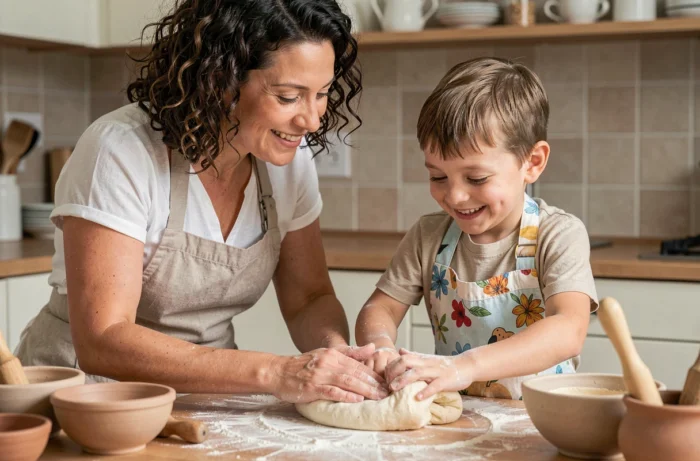
Rather than imposing prohibitions, invite the child to participate in creating the rules. Together, we set the usage times, the allowed content, and the screen-free moments (meals, bedtime). A child who co-constructs the rule respects it more than a child who simply endures it.
Listening to the child’s emotions: going beyond just “calm down”
When a child cries out of frustration, the common reflex is to say “calm down” or “it’s nothing.” These phrases deny what the child is feeling. Kind listening involves naming the emotion before trying to solve the problem.
By saying “you are angry because your tower fell down,” you accomplish two things. The child feels understood. And they gradually learn the vocabulary of their own emotions, which forms the basis of emotional management in children.
This skill doesn’t develop in a day. It builds through repetition, situation after situation. Over the weeks, the child begins to identify what they feel, sometimes even before they overflow.
- Name the observed emotion (“I see that you are sad”) rather than deny it
- Validate the feeling before proposing a solution (“it’s normal to be frustrated”)
- Wait for the emotional intensity to decrease before explaining or reasoning
This last point is often overlooked. A child overwhelmed by a strong emotion cannot reason. Waiting a few minutes before discussing radically changes the outcome of the situation.
Gentle parenting is not an unreachable ideal reserved for perfect parents. It is a set of reflexes that can be practiced, sometimes missed, and repaired. The legal framework, the guidelines on screens, and the ability to name emotions form three concrete pillars, applicable starting tonight.