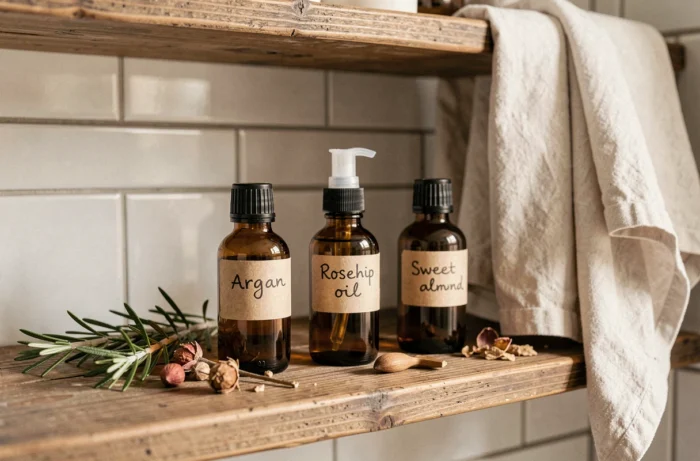
Replacing jojoba oil in a skincare routine involves identifying what this liquid wax specifically provides, and then measuring what each alternative covers or does not cover. Jojoba stands out due to its similarity to human sebum, its high oxidative stability, and its non-comedogenic profile. Not all vegetable oils tick all three boxes simultaneously, and this is where the choice becomes an exercise in comparison rather than simple substitution.
Comparative profile of the main alternatives to jojoba oil
The table below confronts the characteristics of jojoba with those of five common alternatives in natural cosmetics. The criteria selected are those that directly influence the choice of a substitute: texture, comedogenicity, target skin type, and dominant fatty acid.
| Vegetable Oil | Texture | Comedogenicity | Target Skin Type | Dominant Fatty Acid |
|---|---|---|---|---|
| Jojoba (reference) | Liquid wax, dry finish | Very low | All types | Gadoleic acid |
| Hazelnut | Dry, quick absorption | Very low | Combination to oily | Oleic acid |
| Grapeseed | Very fluid, dry finish | Low | Oily, acne-prone | Linoleic acid |
| Sweet almond | Rich, slow absorption | Moderate | Dry, sensitive | Oleic acid |
| Argan | Slightly rich | Low | Mature, dry | Oleic + linoleic acid |
| Vegetable squalane | Ultra-light, invisible finish | None | Sensitive, acne-prone | Saturated hydrocarbon (squalane) |
What stands out immediately: no oil exactly replicates the profile of jojoba. Hazelnut comes close in texture and low comedogenicity, but its dominant fatty acid differs. Vegetable squalane offers even higher tolerance, with a drier finish, yet does not provide the same richness in protective waxes.
When asking what to replace jojoba oil with, the answer thus depends on the priority criterion: sebum regulation, deep nourishment, or simple skin tolerance.
Hazelnut oil and vegetable squalane: two underestimated substitutes
Hazelnut oil deserves special attention. Its quick absorption and dry touch position it as the closest substitute to jojoba for combination to oily skin. It regulates sebum production without leaving a greasy film, a point where sweet almond or argan are less effective.
Vegetable squalane, on the other hand, is not an oil in the strict sense. It is a hydrocarbon derived from olive or sugarcane, whose molecular structure is identical to the squalene naturally present in the skin. Its zero comedogenicity and tolerance on reactive skin make it a relevant option for those who abandon jojoba due to skin sensitivity or acne-prone conditions.
However, squalane does not provide essential fatty acids. For dry skin that needs nourishment, it is not sufficient on its own. The combination of squalane + a few drops of grapeseed oil can compensate for this lack, combining lightness with a supply of linoleic acid.
Linoleic acid and acne-prone skin: a decisive choice criterion
Oils rich in linoleic acid represent an often-overlooked angle in the search for a substitute for jojoba. Several recent sources highlight that acne-prone skin tends to have a deficiency in linoleic acid in its sebum, which promotes pore blockage.
Grapeseed oil concentrates a high proportion of this fatty acid. It penetrates quickly, leaves no occlusive residue, and helps rebalance the skin’s lipid profile. Conversely, oils dominated by oleic acid (sweet almond, argan) can worsen imperfections on this skin type.
- Grapeseed oil: rich in linoleic acid, very fluid texture, suitable for facial care for oily skin
- Hemp oil: also rich in linoleic acid and omega-3, non-comedogenic, with a slightly richer finish
- Black seed oil: marked anti-imperfection profile, but pronounced odor that may limit its use in daily care
The choice of the dominant fatty acid conditions the effectiveness of the substitute far more than the reputation of the oil. A “noble” oil poorly chosen can exacerbate a skin imbalance, while a more modest oil but suited to the skin’s lipid profile will yield better results.
Application on damp skin: a technique that changes the results
One aspect rarely addressed in comparisons of vegetable oils concerns the method of application. Applying a substitute oil on dry skin can create a feeling of occlusive film without real hydration. Several recent recommendations emphasize the importance of applying the oil on damp skin, after a mist or hydrosol.
The logic is simple: the oil forms a barrier that limits the evaporation of water already present on the skin. Without this water, the oil nourishes but does not hydrate. This technique applies to all the alternatives listed, and it can transform the user experience of an oil deemed “too rich” or “not hydrating enough.”
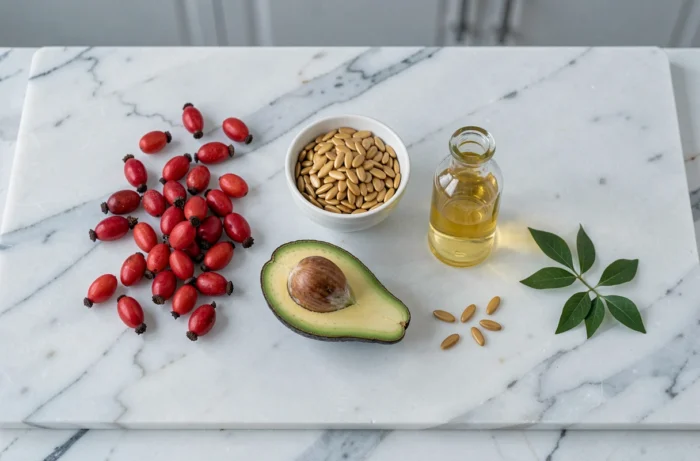
For very dry areas (elbows, heels, hands), shea butter remains a more targeted substitute better suited than a fluid oil. Its semi-solid consistency offers superior occlusivity, but it does not replace jojoba on the face due to its thick texture.
Skin test and limitations of vegetable oils
Not all vegetable oils are suitable for all skin types, including those reputed to be “universal.” A 24-hour patch test in the elbow crease remains the only reliable way to rule out an allergic reaction related to the plant source.
- Sweet almond oil can cause reactions in individuals allergic to nuts
- Black seed oil, despite its properties, irritates some sensitive skin at high concentrations
- Vegetable squalane presents the least allergenic risks due to its simplified molecular structure
The logic of “replacement” assumes that jojoba was working well. If you change oils because your skin has evolved (pregnancy, hormonal changes, dermatological treatment), the ideal substitute is not necessarily the oil closest to jojoba but the one that matches your new skin profile. The comparative table at the beginning of the article allows you to cross-reference texture, comedogenicity, and skin type to refine this choice.