
Credelio is a chewable tablet prescribed to treat fleas and ticks in cats. It contains lotilaner, a molecule from the isoxazoline family. Dewormers, by contrast, target intestinal, lung or heartworms using different active ingredients (praziquantel, milbemycin, fenbendazole). When both treatments are due on the same day, it is natural to wonder whether they can be given together.
Lotilaner and deworming active ingredients: what the lack of documented interactions tells us
Lotilaner acts on the nervous system of ectoparasites (fleas and ticks). Common dewormers work through different pharmacological pathways: praziquantel paralyzes tapeworms, while milbemycin disrupts nerve transmission in roundworms. These mechanisms do not overlap.
No drug interactions between lotilaner and common deworming compounds are reported in the available sources, including the FDA labeling for Credelio CAT, updated in January 2025. On this basis, giving them on the same day is generally considered an option.
The important caveat is the word “option.” The absence of reported interactions is not formal proof of universal compatibility. Pharmacovigilance data rely on spontaneous reports of adverse events, a system that structurally underestimates the true frequency of reactions. Before giving both treatments, veterinary approval remains the only reliable safeguard, since your vet knows your cat’s medical history and any individual contraindications.
In most cases, it is possible to give Credelio and a dewormer to a cat on the same day, provided your vet has approved the choice of active ingredients for your pet.
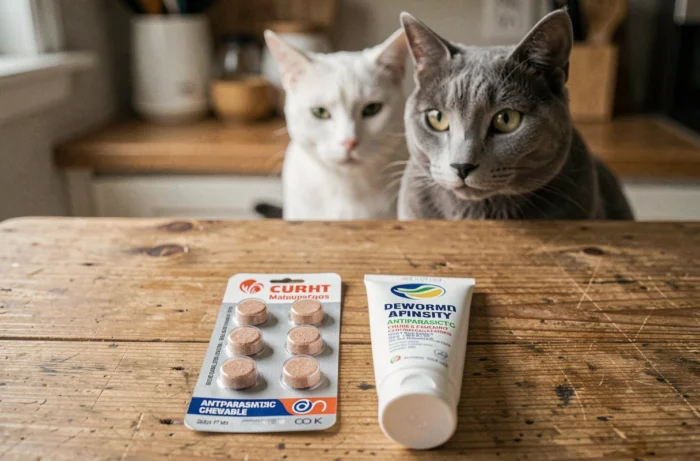
Credelio for cats and food requirements: a detail that complicates giving both treatments together
Credelio tablets must be given with food. This is more than a practical tip: taking it with a meal is essential for lotilaner absorption. Without food, the product’s bioavailability decreases, which may reduce its effectiveness against fleas and ticks.
The challenge arises when the chosen dewormer has its own food instructions. Some dewormers should be given on an empty stomach, others with food, while others can be given regardless of mealtimes. If the two products require opposite conditions, giving them on the same day in the same circumstances can become a logistical headache.
A simple solution is to space the doses a few hours apart on the same day: give Credelio with breakfast and the dewormer in the evening, following its own instructions (or vice versa). This approach respects each product’s administration requirements without disrupting the parasite-control schedule.
Side effects and neurological monitoring: what applies to Credelio alone
Isoxazolines, the chemical family to which lotilaner belongs, carry a specific FDA warning about possible neurological effects in treated animals, including muscle tremors, balance problems and seizures. These reports are rare according to the labeling, but they can occur regardless of whether a dewormer is also given.
If a cat receives two treatments on the same day and develops unusual symptoms, it becomes harder to identify which product is responsible. This makes diagnosis more difficult for the vet. It is one reason to consider spacing the treatments a few days apart for a vulnerable cat or one receiving them for the first time.
Signs that warrant a call to the vet after giving both treatments
- Repeated vomiting in the hours after dosing, especially if the Credelio tablet may have been regurgitated (in which case its effectiveness is no longer guaranteed)
- Loss of appetite lasting more than 24 hours, with or without diarrhea
- Any neurological signs, even mild ones: unsteady walking, tremors or an unusual fixed stare
- A noticeable increase in breathing rate while at rest
These signs are not specific to giving both treatments together. They are among the possible side effects of Credelio taken alone. Monitor your cat after every dose.
Choosing a dewormer based on the worms targeted when your cat is taking Credelio
The choice of dewormer does not depend on Credelio, but on the types of worms your cat may be exposed to. Lotilaner has no effect on internal parasites, so the deworming treatment must cover the full range of parasites relevant to your cat’s circumstances.
A cat that gets fleas is at direct risk of infection with Dipylidium caninum, a tapeworm transmitted when a cat grooms itself and swallows an infected flea. Praziquantel is the standard treatment for this tapeworm. Outdoor cats are also exposed to roundworms (ascarids and hookworms) and, in some regions, lungworms or heartworms, which require other active ingredients such as milbemycin oxime or fenbendazole.
A broad-spectrum dewormer (for example, praziquantel + milbemycin) covers the most common situations. Your vet can refine the choice based on a fecal test or your location. Choosing by active ingredient rather than brand name helps avoid unnecessary duplication and gaps in coverage.

Parasite-control schedule: coordinating Credelio and deworming without overdosing
Credelio is given monthly. Adult cats are generally recommended to be dewormed every three months if they go outdoors, and twice a year if they live strictly indoors. These different schedules naturally fall out of sync.
Giving both treatments on the same day, every three months for example, makes them easier to keep track of. In the intervening months, only Credelio needs to be given. This schedule works as long as your vet confirms the deworming frequency suited to your cat’s lifestyle.
- Strictly indoor cat: deworm twice a year; give Credelio monthly if there is a risk of fleas (for example, if the cat lives with a dog that goes outdoors)
- Cat with regular outdoor access: deworm every three months; give Credelio monthly year-round, depending on the region
- Kitten under six months old: more frequent deworming is needed, and according to the FDA labeling, Credelio’s use against ticks has not been evaluated in this age group
The most commonly overlooked issue is not the day the treatments are given, but sticking to the schedule. A delay of several weeks in deworming can expose your cat to a parasite burden that builds up silently, while you assume your pet is protected because its flea treatment is up to date. Credelio protects against fleas and ticks, not worms: the two treatments address different threats and cannot replace one another.