Pampers does not manufacture nappies in France. All products intended for the French market come from European sites, mainly in Germany. This raises a practical question: how can consumers check where a pack bought in a supermarket actually comes from?
Pampers batch codes and traceability: identifying the factory behind a specific pack
Procter & Gamble prints a batch code on every pack of nappies, usually on the back or on the bottom flap of the packaging. This alphanumeric code is used for internal production tracking and product recall procedures.
The problem is that P&G does not provide the general public with a decoding chart linking a batch code to a specific factory. The product information lists “Procter & Gamble” as the manufacturer, sometimes with a head office address, but not the actual production site. Consumers looking to find out where Pampers nappies are made for the French market run up against this structural lack of transparency.
There are two ways to obtain this information:
- Contact P&G Consumer Services and provide the full batch code. In theory, advisers can trace the supply chain and identify the factory of origin.
- Check the mandatory regulatory information on the packaging. EU regulations require the name of the person responsible for placing the product on the market, but not the address of the manufacturing plant. The information is therefore incomplete.
- Check whether the pack has an additional marking such as “Made in Germany” or a country code. Some batches display one, while others do not, depending on the packaging format and production line.
As things stand, factory-by-factory traceability is not transparent to end consumers. The only certainty is that Pampers’ European production relies on a network of industrial sites, with Euskirchen in Germany as a key hub.
The Pampers factory in Euskirchen: Germany’s role in European production
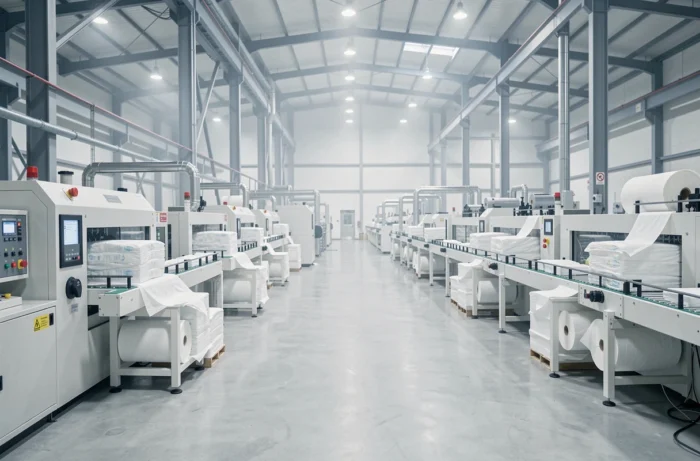
The Euskirchen site in North Rhine-Westphalia is regularly described as one of Pampers’ largest production facilities in Europe. According to LSA Conso, this factory accounts for around 40% of the brand’s European production. Production rates are reported to reach a thousand nappies per minute on each production line.
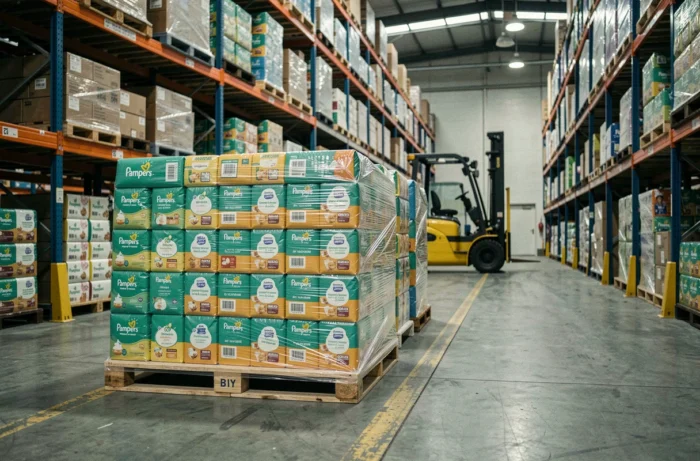
This concentration has a direct impact on the French market. Most packs of Pampers sold in France are shipped from Germany or from other P&G sites in Europe. Transport remains economically viable because nappies, although bulky, are very lightweight. Intra-European logistics costs are still lower than the operating costs of a small local facility.
Why are there so few nappy factories in France?
An article in Les Echos highlighted this paradox back in 2015: France, then Europe’s largest market with more than 800,000 births a year, had only two nappy factories (across all brands) and five production lines, covering around 15% of domestic demand.
The explanation lies in the structure of the market. Pampers accounts for around two-thirds of sales in France, and P&G has streamlined production around large European facilities. Highly automated production lines require little labour, making it less attractive to set up in a country with higher labour costs. Industrial efficiency takes priority over being close to consumers.
Pampers production worldwide: beyond Europe
P&G’s global network for the Pampers brand serves the main consumer markets. Production is organised by major geographic regions to limit intercontinental shipping.
- In North America, P&G operates several factories in the United States, historically the brand’s largest market since its launch in 1965.
- In Asia, production sites supply the Japanese, Chinese and Southeast Asian markets, where nappy formats and product ranges differ significantly from their European counterparts.
- In the Middle East and Africa, P&G has developed local production capacity to meet the population growth in these regions.
Each region has production lines tailored to local specifications (sizes, materials and standards). A pack of Pampers sold in Japan is not made from the same materials as one sold in France, even if both carry the same product range name. Production therefore remains highly regionalised.
Alternatives made in France: what is actually available?
Consumers who want to buy nappies made in France do have options, but they remain a minority. Several manufacturers, often positioned in the eco-friendly or free-from segment, operate small production lines in France.
These companies cannot match Pampers in terms of volume. Their production capacity covers only a fraction of the domestic market. The price per nappy is generally higher, reflecting both lower production volumes and stricter requirements for raw materials.
Made-in-France baby nappies remain a niche market, driven by growing demand but structurally limited by the competitiveness gap with P&G’s large factories in Germany and Eastern Europe.
The question of where Pampers nappies come from therefore has a straightforward technical answer: there is no production in France, the brand relies heavily on the Euskirchen site, and there is no public tool for linking a batch code to a factory without contacting P&G Consumer Services. For parents who care about geographic traceability, the choice depends more on the brand than on the Pampers label.