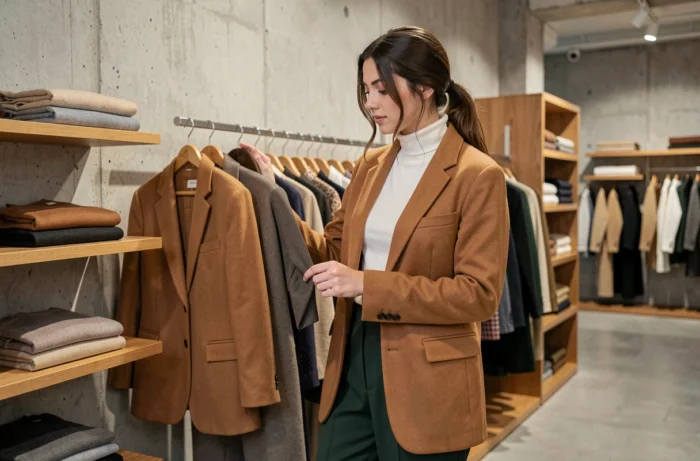
The autumn-winter 2026 season confirms a structural shift: collections are no longer interpreted solely by their silhouettes or palettes, but by their compliance with a European regulatory framework that redefines what a brand can communicate about its products. Current fashion trends are situated within this dual reading, between bold stylistic proposals and unprecedented normative constraints.
Anti-greenwashing directive and fashion: what changes on September 27, 2026
The European directive (EU) 2024/825, known as “Empowering Consumers for the Green Transition,” becomes fully applicable on September 27, 2026. We observe that its impact on the textile sector far exceeds the communication aspect.
Generic terms such as “eco-friendly,” “green,” “sustainable,” or “zero impact” are now prohibited without verifiable proof of recognized environmental performance throughout the entire product lifecycle. The required reference is the European Ecolabel or a type I label compliant with the EN ISO 14024 standard.
Private “in-house” labels (green badges, leaf logos, “conscious collection”) are prohibited unless they are based on independent certification with regular audits. In practical terms, a large part of the “responsible” marketing of capsule collections from fashion brands is being called into question.
Statements like “carbon neutral” or “zero emissions” can no longer primarily rely on carbon offsetting. For brands that had built their spring-summer or autumn-winter positioning on these claims, redesigning product sheets and packaging is an immediate task.
We regularly follow the news on modeforyou.fr to measure how brands adjust their messaging in light of these new obligations.

Leather, denim, and structured pieces: the key materials of the season
Leather makes a massive comeback on the autumn-winter runways. Not the soft and draped leather of previous seasons, but a rigid leather, crafted in architectural panels. Leather jackets, skirts, and dresses adopt geometric cuts reminiscent of the 1980s.
Denim confirms its status as a central piece, but in less expected forms. Surface treatments (resin coating, waxing, localized laser fading) take precedence over raw denim. Silhouettes range between structured baggy and high-waisted slim, depending on the brands.
- Full-grain leather returns on outerwear with matte finishes, far from the gloss of past seasons
- Technical denim incorporates next-generation stretch fibers for fitted cuts without loss of shape
- Certified recycled materials are gaining ground but must now display complete traceability to comply with the (EU) 2024/825 directive
The dress, a key piece of fashion week, is available this season in midi and maxi versions. Dominant colors remain burgundy, chocolate brown, and off-white, with a notable return of bright red for evening looks.
Autumn-winter color trends: beyond conventional palettes
This season’s color palettes tell a story of transition. The ubiquitous beige of recent years recedes in favor of saturated shades worn in total looks. Red, already identified during the spring-summer shows, is firmly establishing itself in the cold season.
We recommend distinguishing two families of colors that structure current collections. On one side, warm and deep tones (rust, caramel, plum) dominate everyday wardrobes. On the other, vibrant colors (poppy red, electric blue, emerald green) are reserved for standout pieces.

Black remains a foundation, but its treatment evolves towards mixed textures within the same outfit: matte leather paired with ribbed knit, satin combined with technical cotton. This textured approach to monochrome characterizes the most refined proposals of the season.
The return of 1990s contrast
Black and white combinations resurface in graphic proportions. Checkerboard prints, thick stripes, and bi-color blocks recall a visual grammar that had disappeared since the end of the 2010s. Skirts and coats are the pieces that best embody this contrasting style.
Fashion and textile traceability: a purchasing criterion that has become technical
Traceability is no longer a marketing argument; it is an obligation currently being deployed. The digital product passport, mandated by the European regulation on eco-design, will gradually apply to textiles. Each garment will ultimately need to carry an identifier that allows tracing its manufacturing chain.
Brands that anticipate this requirement are already distinguishing themselves by integrating QR codes on their labels, linking to detailed sheets outlining the origin of materials, manufacturing locations, and certifications obtained.
- OEKO-TEX certification is strengthening its governance to align with future European requirements
- The second-hand market is consolidating in Europe, driven by Generation Z
- Fast-fashion brands need to rethink their product communication model to avoid sanctions related to unproven environmental claims
For informed buyers, the reflex to adopt this season is not only to check the cut or material but to verify the actual presence of third-party certification on the label. A green logo without a certificate number or identifiable organization no longer holds legal value in the European Union since the directive came into effect.
The autumn-winter 2026 fashion is thus read on two simultaneous levels: bold stylistic proposals (structured leather, technical denim, saturated colors) and a regulatory framework that transforms how collections are presented, labeled, and sold. Style is no longer enough; proof accompanies it.