
A children’s garment without a size label is not a lost garment. The mention of size is not mandatory under French and European law for handmade creations or small textile series: only the composition is required. Knowing how to measure flat with a tape measure remains the only reliable method, whether the piece comes from a garage sale, a second-hand lot, or unwrapped stock.
Flat measurement points according to the type of children’s piece
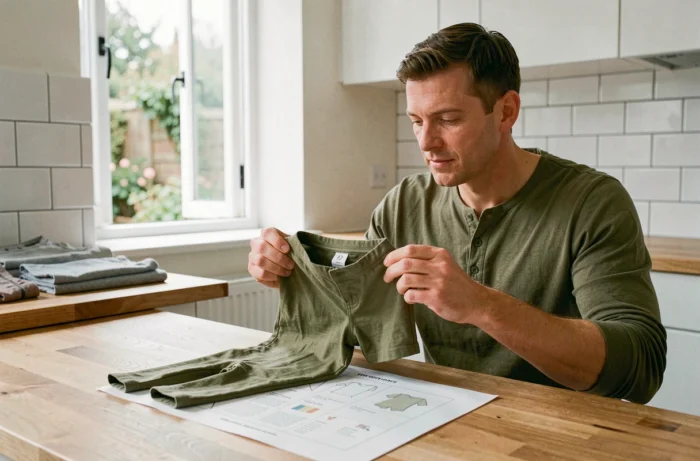
Measuring flat on a hard, flat surface is the only reliable basis for work. A hanger distorts the shoulders, and a mannequin stretches the fabric. Three to five measurements are sufficient depending on the piece.
For a top (t-shirt, bodysuit, sweater), the two key measurements are chest width (armpit to armpit) and total length (from the base of the collar to the bottom of the hem). Shoulder width, taken between the two sleeve seams, differentiates a 4-year-old from a 6-year-old when the body length is similar.
For pants or leggings, we take the half-waist width (unstretched elastic waistband), inseam length (from the inner seam to the bottom hem), and total length from the waist. For rigid children’s jeans, hip width at mid-hip completes the diagnosis.
The safest reflex for recognizing the size of a children’s garment is to place the unknown piece next to a garment of known size of the same type, on the same surface.
- Bodysuit or baby romper: measure the total length from the neckline to the inseam, then the chest width.
- Dress or tunic: chest width, shoulder-hem length, and waist circumference if the cut is fitted. Length alone is not sufficient, as cuts vary significantly from one brand to another.
<liJacket or coat: also measure the sleeve length from the shoulder to the wrist, as this is often the criterion that indicates a size too small even before the chest measurement.
Correspondence between measurements and children’s sizes: reading a chart without making mistakes
In France, the indicated size corresponds to height in centimeters. A garment marked “104” is intended for a child measuring about 104 cm. The age indicated (4 years, 6 years) is only an approximation based on average growth curves.
Without a label, it is this height that must be reconstructed from flat measurements. The table below serves as a basic reference for children’s tops (excluding babies).
| Indicative Height | Average Age | Flat Chest Width | Total Length (top) |
|---|---|---|---|
| 98 cm | 3 years | 27-28 cm | 37-39 cm |
| 104 cm | 4 years | 28-30 cm | 40-42 cm |
| 110 cm | 5 years | 30-31 cm | 43-45 cm |
| 116 cm | 6 years | 31-33 cm | 46-48 cm |
| 128 cm | 8 years | 34-36 cm | 50-53 cm |
| 140 cm | 10 years | 37-39 cm | 55-58 cm |
These ranges apply to standard cuts. Comparing with a reference garment from the same brand remains more reliable than a generic chart, which does not take into account differences in patterning.
Discrepancies between brands: why two “6 years” do not measure the same
Each brand builds its patterns based on its own reference measurements. Positioning plays a direct role: loose sportswear, fitted ready-to-wear, growth-adjustable clothing. A “6 years” t-shirt from a mass-market brand may display 2 to 3 cm more in chest width than a “6 years” t-shirt from a high-end brand.
When faced with a garment without a label, this ambiguity prevents reliance on a single dimension. Cross-referencing at least three measurements (chest width, total length, sleeve length) reduces the risk of error by a whole size.
Baby clothes: height takes precedence over age
For infants, the age-height correspondence is even less reliable. A 6-month-old baby may wear 9 months if their growth curve exceeds the median.
For bodysuits and pajamas without labels, total length (from collar to inseam for a bodysuit, from collar to feet for pajamas) remains the most discriminating criterion.
Estimating the size of children’s pants without a tape measure
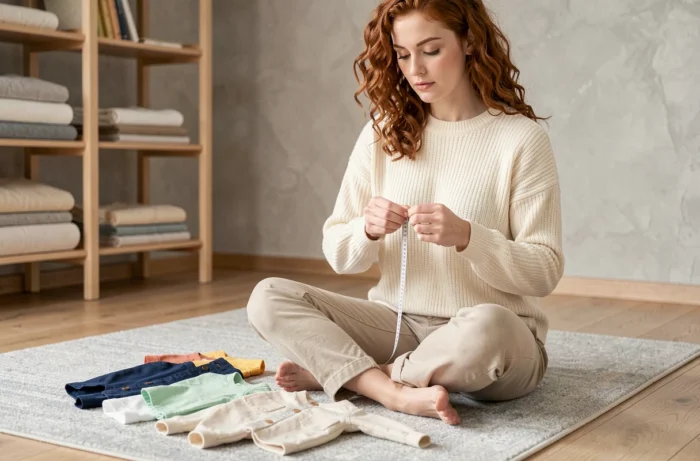
At a garage sale or flea market, flat measurement is not always feasible. A few quick checks can help sort a lot of unlabeled pants directly on the child.
For waist circumference, folding the pants and positioning the waistband against the child’s belly provides a first visual reference. For length, holding the pants along the child’s leg, from the waist to the ankle, allows checking if the inseam falls at the right level.
These quick checks serve as an initial filter, not a definitive measurement. For online resale, only measurements in centimeters, taken flat and indicated in the listing, give confidence to the buyer. A garment without a label with precise measurements sells as well as a labeled garment, provided that the dimensions are clearly documented.