The leisure market in 2026 is increasingly segmented between time-consuming practices and low-commitment activities. For those looking to disconnect without turning their free time into a second job, sorting through current trends requires specific criteria.
Trendy leisure and mental load: filter before committing
A hobby that requires a regular investment of several hours per week, expensive equipment, or a long learning curve does not serve the same purpose as an activity designed for disconnection. We observe that most lists of trendy leisure activities mix these two categories without distinction.
The discriminating criterion boils down to one question: does the leisure activity produce a result from the very first session, or does it require weeks of practice before providing satisfaction? Slow crafting activities, which rely on analog techniques and an accepted imperfection, meet this filter. Punch needle or simple macramé yield a finished object in a session of less than an hour.
Conversely, epoxy resin, often highlighted in creative trends, requires drying time, a dedicated space, and mastery of measurements. Among the leisure activities presented on Wow Magazine, this distinction between immediate accessibility and progressive commitment is rarely made explicit, complicating the choice.
- Setup time: prioritize activities that do not require lengthy setup or bulky equipment.
- Minimum frequency for progress: a disconnection hobby should not impose any regular rhythm to remain enjoyable.
- Real entry cost: beyond the starter kit, some creative hobbies lead to recurring purchases of consumables (threads, pigments, supports).
Slow crafting and manual practices: what works without a screen
Slow crafting is establishing itself in 2026 as a direct response to digital saturation. The principle: return to tactile materials, accept the irregularities of handmade work, and step away from “Instagrammable” content logic. This positioning changes the very nature of leisure.
Specifically, we recommend distinguishing two families of manual practices based on their relationship to time.
The first group includes short session activities with immediate results. Knitting small items (hats, pouches), making simple jewelry from beads or wire, basic papercraft. These formats are suitable for time slots of 30 to 45 minutes, with no preparation or tedious cleanup.
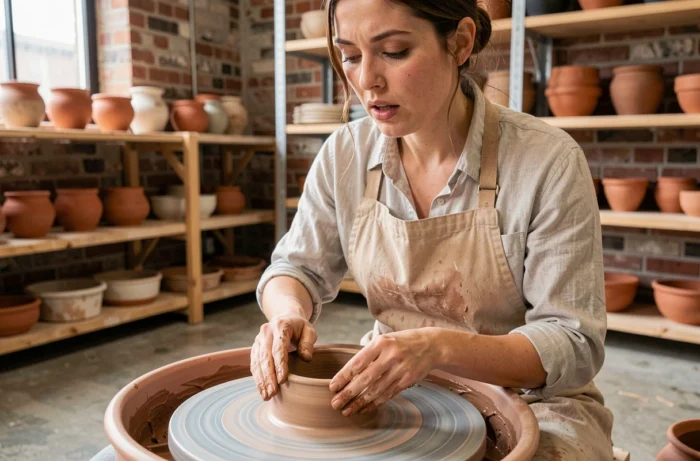
The second group concerns long-term projects: sewing clothes, interior woodworking, pottery on a wheel. These practices provide a deep flow, but require a workshop or at least a permanent workspace. For someone who wants to disconnect without logistical constraints, the first category remains more suitable.
A manual creation session of about 45 minutes can significantly reduce stress by fostering a state of concentration close to flow. This benefit does not depend on technical skill: it is the sensory dimension and the absence of screens that matter.
Group workshop or solo practice
Craft parties and shared workshops are gaining ground. The format is simple: a location, a material, a common project completed in a group over two hours. These sessions function as a low-commitment social leisure activity, as the materials are provided and guidance is included.
For those who prefer solitude, ready-to-use kits (paint by numbers, pre-drawn embroidery) offer a frictionless entry. The outcome is guided, which eliminates the sometimes paralyzing phase of creative decision-making for beginners.
Hybrid offline-digital leisure: personalization without screen dependence
The most structuring trend of 2026 combines manual skills and occasional digital tools. Digital tools come into play beforehand (downloaded pattern, short video tutorial) or afterward (scanning a creation to share or sell), but the practice itself remains disconnected.
Scrapbooking illustrates this hybrid model well. Templates and designs are retrieved online, while assembly is entirely analog. Personalization assisted by digital cutting tools (like Cricut or Silhouette) speeds up certain steps without turning the leisure activity into a screen-based one.
This hybrid format also responds to the growing boundary between leisure and complementary monetization. Several trendy practices of 2026 are designed to generate income through the sale of handmade items or occasional teaching of their technique. Making handmade jewelry or small decorative pieces fits into this logic without requiring industrial production volume.
Games and escape rooms: disconnection through immersion
Outside of creative hobbies, immersive activities like escape rooms or modern board games offer disconnection through cognitive engagement. Their advantage: a fixed time slot (one to two hours), no personal equipment to acquire, a complete experience at each session.
At-home escape rooms (box kits) have multiplied and allow for this immersion to be recreated with family or friends without reservations or travel. The format remains occasional, which suits someone who refuses a hobby with a set schedule.
Concrete criteria for choosing a leisure activity without time constraints
Rather than following a trend just because it is visible on social media, we recommend applying a simple selection grid.
- Session autonomy: the leisure activity should be able to be practiced in isolated sessions, without mandatory continuity from one to the next.
- Material footprint: everything needed fits in a bag or drawer, not in a dedicated room.
- Skill threshold: the first creation should be satisfying, even if imperfect, to maintain motivation.
- Social compatibility: the leisure activity can be practiced alone or with others without degrading either mode.
A leisure activity that checks these four points has a good chance of surviving beyond the initial enthusiasm. Trends come and go, but a hobby that respects your time budget lasts over time. It is better to have a modest activity practiced regularly than a spectacular enthusiasm abandoned after three weeks.