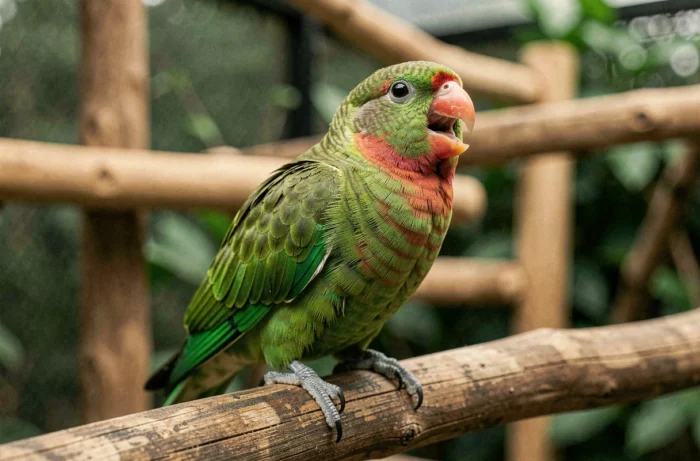
The kakariki does not speak like a grey parrot from Gabon or an Amazon parrot. Its voice is higher-pitched, its imitations less clear, and its vocal attempts often go unnoticed. Recognizing a talking kakariki requires paying attention to discreet signals, both auditory and physical, that most owners confuse with mere background noise.
Contact Calls and Vocalizations of the Kakariki: What Constitutes Language
Wild kakariki in New Zealand use short and repetitive contact calls to maintain their bond with their group while remaining discreet in the presence of predators. In captivity, this reflex persists. The bird emits a series of short, high-pitched chirps, often on the same note, directed towards its owner or a companion.
This type of vocalization is not random chatter. The contact call has a specific function: to locate, reassure, and signal presence. When a kakariki repeats a specific sound each time its owner returns to the room, it associates that sound with a situation. This is the first sign of contextual imitation ability.
Collaborative projects of participatory science on parrots show that even small species of parakeets use label words for individuals or situations. The kakariki falls into this category: its imitations are rare but targeted.
Field reports vary on this point, as some individuals never imitate human sounds while others reproduce identifiable syllables. To delve deeper into the matter, one can consult how to know if a kakariki talks on Amazing Pet Place, which details the auditory criteria to observe.
Body Language of the Kakariki: Postures Accompanying the Voice
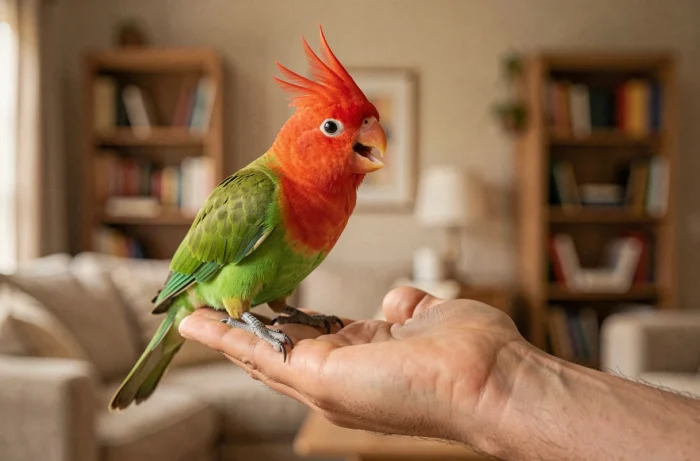
A kakariki attempting to communicate does not just vocalize. Its body accompanies the sound, and it is often movement that distinguishes a speech attempt from a simple cry of excitement.
Head Movements and Eye Orientation
When a kakariki tilts its head to the side while emitting a sound, it is listening and seeking a response. This side-to-side head bob is a marker of active attention. The bird fixes its gaze on its interlocutor with one eye, adjusts the angle of its head, and then reproduces (or attempts to reproduce) the heard sound.
Conversely, a kakariki that screams while looking into the distance, with its body tense and wings slightly spread, expresses agitation or alertness. This is not an attempt at communication directed towards a human.
Position of Feathers and Beak
Slightly puffed feathers accompanied by a soft chirp indicate a relaxed state conducive to vocal learning. The bird mumbles, tests sounds, modulates its voice. It is during these calm phases that kakariki produce their best imitations.
A beak that snaps or opens wide without producing sound falls into another category (discomfort, warning). The soft chirping and relaxed feathers create the ideal context for spotting a speech attempt.
Differentiating a Kakariki That Imitates from One That Vocalizes
All kakariki vocalize. Few actually imitate. Confusion between the two is common and leads to misinterpretations.
- Natural vocalization includes contact calls, chirps, and whistles. These sounds are part of the species’ innate repertoire and do not vary based on the human environment.
- Imitation is characterized by a sound that does not belong to the bird’s usual repertoire: a human syllable, a domestic noise (ringing, beep), a specific melody heard repeatedly.
- The decisive criterion is contextual repetition: does the bird produce this sound in a specific situation, directed at a specific person, or randomly throughout the day?
An EAM (hand-raised) kakariki is more likely to produce imitations, as its early exposure to the human voice promotes learning. The available data do not allow us to conclude that a non-EAM kakariki will never talk, but testimonies converge towards a significantly lower probability.
Encouraging Speech in a Kakariki: Conditions and Limits
The kakariki is not a parrot known for its vocal abilities. Expecting complete sentences from it would be a miscalibration. However, certain conditions favor the emergence of imitations.
- Repetition of a short word (maximum two syllables) in a high-pitched tone, pronounced in the same context every day, yields the best results. Kakariki are better at picking up high frequencies than low voices.
- A calm environment during chirping phases allows the bird to practice without sound competition. Kakariki are often more vocal in the late morning and late afternoon.
- The presence of a single regular human interlocutor promotes the association between a sound and a person. A kakariki solicited by several different voices will have more difficulty fixing an imitation.
A kakariki that mumbles alone in its cage at the end of the day is in a learning phase. Interrupting these moments with noise or abrupt interaction disrupts the process. Observing without intervening remains the best approach during these sequences.
Kakariki do not progress linearly. A bird may seem to abandon an imitation for several weeks, then suddenly reproduce it in an unexpected context. This irregularity is normal and does not signify a failure in learning.
Monitoring vocalizations, as practiced in New Zealand conservation programs, reminds us that in this species, each bird develops its own vocal repertoire. In captivity, this uniqueness is evident: two kakariki from the same breeding, exposed to the same sounds, will not produce the same imitations.