A washed and reused glass yogurt pot prevents the production of new packaging. A second-hand jean sold on a resale platform extends its lifespan by several years. These gestures, seemingly simple, rely on two distinct mechanisms: recycling and reuse. Understanding their difference allows you to choose the one that truly reduces your daily waste production.
Reuse and recycling: two pathways, two impacts on resources
Recycling transforms waste into new raw materials. Glass becomes glass again, cardboard becomes cardboard again. Reuse, on the other hand, keeps the product as is: a donated piece of furniture, a deposit container, a resold garment.
The difference in impact is clear. Reuse avoids the industrial transformation phase, thus the energy and water consumption it entails. Recycling a plastic bottle requires shredding, melting, and reforming it. Reusing it only requires washing.
In France, the AGEC law sets a target of 10% of reused packaging by 2027. In 2024, this rate was capped at 1.82%. The gap shows that reuse remains marginal despite its proven effectiveness in reducing waste. To find objects, furniture, or materials to reuse near you, platforms like YaKar facilitate connections between individuals and professionals engaged in this approach.

Reusable packaging: what the ReUse system from Citeo changes
Have you noticed deposit containers in supermarkets? Since June 2025, the ReUse system from Citeo has been rolling out large-scale reuse of packaging in Brittany, Normandy, Pays de la Loire, and Hauts-de-France.
The numbers give an idea of the scale: over 360 stores are participating, six brands are involved, and around 170 product references are affected. The area serves 16 million consumers.
Two technical conditions rarely explained
The standardization of containers is the key to large-scale reuse. If each brand uses a different format, sorting and washing become impossible to industrialize. ReUse imposes common formats so that multiple brands share the same container.
The second condition is the pooling of logistics. Collecting, washing, and redistributing packaging is expensive if each manufacturer manages its own loop. By centralizing these operations, the unit cost decreases, making the system viable for brands.
This model complements traditional recycling. A reusable package can be washed and refilled several dozen times before being finally recycled at the end of its life.
Repair bonus: extending the life of objects before recycling
Before throwing away a broken appliance or garment, repair offers a third option. The repair bonus, managed by eco-organizations like ecosystem, subsidizes part of the repair cost with certified professionals.
Repairing an item often costs less than replacing it, especially with this assistance. The program has seen recent acceleration, even though it remains focused on certain product categories (appliances, textiles, electronic equipment).
Why prioritize repair? Because it is upstream of recycling in the waste management hierarchy:
- Source reduction (buying less) remains the most effective action to limit waste production
- Reuse and repair extend the lifespan of products without consuming new resources
- Recycling is a last resort, when the item can no longer be repaired or reused

Sorting your waste correctly: the mistakes that sabotage recycling
Selective sorting seems established, but poorly sorted packaging contaminates an entire recycling batch. A greasy pizza box thrown in the paper bin, for example, makes the batch unusable.
Some concrete reflexes improve sorting quality:
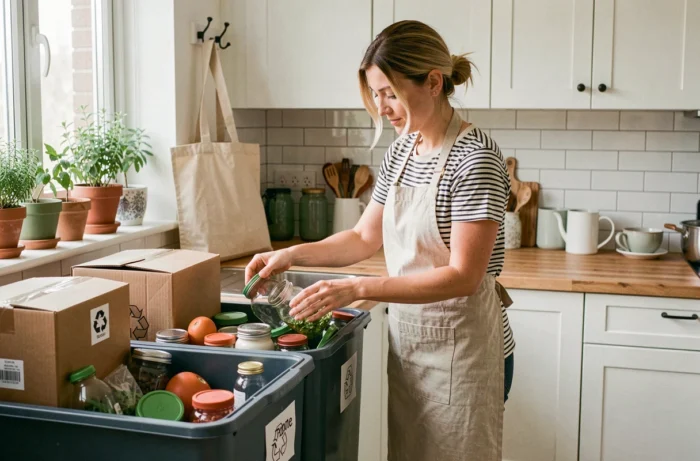
- Empty and rinse food packaging before throwing it in the recycling bin, without washing it thoroughly (a quick rinse is sufficient)
- Do not nest packaging inside each other: a yogurt pot stuck in a tin can prevents optical sorting at the treatment center
- Check local guidelines, as they vary from one community to another, especially for plastic films and trays
- Return small electronic devices to stores or recycling centers instead of putting them in the regular trash
The European regulation on packaging adds design obligations that will facilitate recycling in the coming years. Manufacturers will need to integrate the recyclability of their products from the design stage, which will gradually reduce the share of non-recyclable packaging on the market.
Circular economy: linking recycling, reuse, and consumption
The circular economy is not limited to the act of sorting. It encompasses the production, consumption, and end-of-life of objects in a closed loop. Every second-hand purchase, every repair, every deposit packaging returned to the store feeds this loop.
Adopting a sustainable lifestyle does not require changing everything at once. Starting with a single reflex, such as checking if an item can be reused before throwing it away, already changes your impact on the environment. The most effective action remains the one you repeat every day, even if modest.