
On a Saturday morning, the eldest is drawing a card while the youngest rummages through his piggy bank to “put some money in.” Ten years of marriage are approaching, and the children want to contribute to the gift. This situation is common, often heartwarming, but sometimes complicated to orchestrate when ages range from four to fifteen and resources are not the same.
Gift for the 10th wedding anniversary: what children can really contribute
We first think of money, but the most significant contribution from children rarely comes through the wallet. A framed drawing, a letter dictated and then copied in large letters, a video secretly filmed with a phone: these gestures create a memory that a purchased object online cannot match.
For the older ones, who can keep a secret for a few days, organizing a collective surprise works better than an individual purchase. They can be entrusted with writing a small speech, choosing a family photo to enlarge, or preparing a breakfast tray on the big day. The gift becomes a shared moment, not a transaction.
If you’re looking for a more structured gift idea centered around tin wedding anniversaries, the children’s participation can be added: they sign the card, choose the paper, add a personal note inside the package.
Organizing a family pot when children are of different ages
A fourteen-year-old teenager working in the summer has a different relationship with money than a six-year-old child. Asking them for the same contribution creates an unnecessary imbalance.
Adjusting the amount without putting pressure
The logic of recent wish lists includes options for small amounts and collective contributions. The same principle can be applied in the family: each child gives what they want, even symbolically, and an adult completes to reach the budget of the chosen gift.
- Children under eight participate through a gesture (drawing, note, song) rather than a sum of money.
- Pre-teens can contribute with a few euros from their pocket money, without a fixed amount obligation.
- Teenagers who wish to participate financially do so, but their name appears on the card just like the younger ones, regardless of the amount.
Online pot: an adult supervises
If the family uses a digital pot, a point of caution is necessary. Under French law, a minor cannot make an online payment with a parent’s credit card without the account holder’s consent. In practice, the child can choose their amount, but it is the parent who validates the transaction.
Family experience rather than object: the gift that marks 10 years
Feedback varies on this point, but many couples celebrating their ten years say that the most memorable gift was not a tin object placed on a shelf. It was a dinner prepared by the children (even if clumsy), a family day in a place chosen together, or a compilation of video messages sent by loved ones.
Transforming the gift into a shared experience naturally involves the children. There’s no need to assign them an artificial role: they become actors of the moment.
- A meal prepared together, with a menu decided by the children, even if it ends up being pancakes.
- A handmade photo album, where each child glues their favorite family photos.
- A surprise outing organized by the older ones, in coordination with an uncle or aunt for logistics.

Keeping the secret: the real challenge when children participate
The perfect gift loses its effect if a five-year-old announces the surprise at Tuesday dinner. Adapting the confidence to each child’s age avoids leaks.
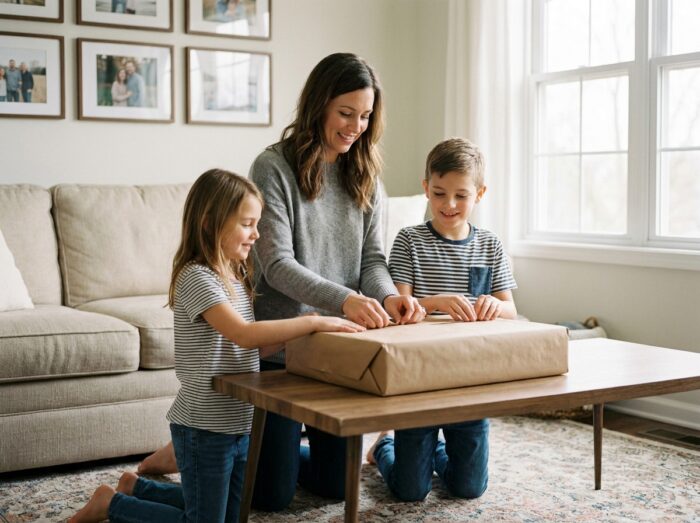
For the little ones, involve them at the last moment: the day before, or even the morning of. They participate in the wrapping, add a drawing, and discover almost at the same time as the recipient. For the older ones, they can be let in on the secret earlier and entrusted with a specific mission (filming, decorating, setting the table).
A reference adult, often a grandparent or close friend, coordinates everything. This discreet conductor role allows the children to feel involved without bearing the responsibility of the entire organization.
Children’s gift and couple’s gift: should they be separated?
Some families choose to distinguish between the “official” gift between spouses and the gift from the children. Others merge everything into a single collective present. Both work, but a gift signed only by the children has an emotional value that is hard to replicate.
A modest object accompanied by a card written by each child often touches more than an expensive gift wrapped by an adult. The gesture matters more than the amount, especially for tin anniversaries where symbolism takes precedence over luxury.
When merging the two, simply ensure that the children’s contribution remains visible: their name on the package, their note inside, their choice of wrapping. The child should be able to say “it’s from me too” without it sounding hollow.
Ten years of marriage is a date that children vaguely perceive as a family milestone. Allowing them a place in the gift, even a tiny one, anchors this milestone. The format matters little: three awkward lines on a piece of paper are worth as much as a tin jewel, as long as the child wrote them themselves.