
The market for unusual accommodations in France has significantly expanded in recent years. Treehouses, yurts, transparent bubbles, tiny houses: the options are plentiful. Choosing an unusual accommodation for your travels, however, requires looking beyond the visual appeal of photos and verifying concrete elements that determine the actual quality of the stay.
Regulations and EPC: What the law requires for unusual accommodations in 2024-2026
Unusual accommodations are no longer a legal blind spot. The Le Meur law of November 19, 2024 mandates an energy performance diagnosis (EPC) of at least class E for any new tourist rental located in a tight zone, including atypical structures rented for short durations.
This requirement has a direct impact on selection. An accommodation provider displaying their EPC rating signals both legal compliance and a minimum level of insulation. Conversely, the absence of any energy mention in a listing deserves scrutiny before booking.
The environmental regulation RE2020 also applies to new atypical constructions (wooden modules, light recreational homes). For travelers, this means that recent structures generally offer better thermal performance than older installations. If you plan to stay in a cabin or bubble outside the summer season, the issue of heating and insulation is not trivial.
For those who wish to explore the variety of accommodation options available, it is possible to learn more on Mamzelle Voyage about the different types of stays offered.
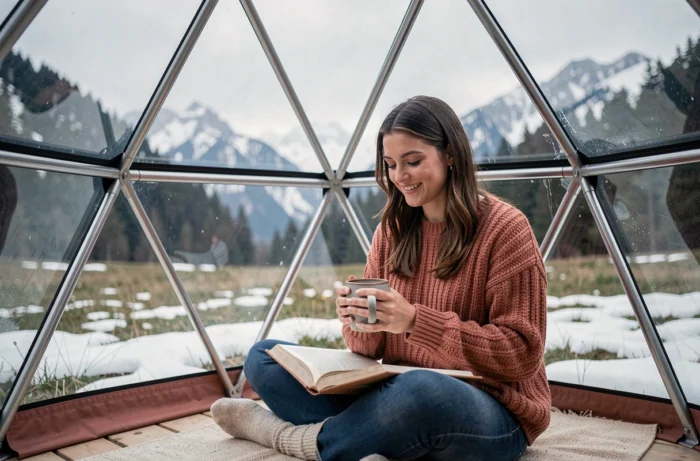
Unusual accommodation in nature: reading a listing beyond the photos
A photo of a treehouse at sunset says nothing about access to sanitary facilities, the quality of bedding, or nighttime noise levels. On-the-ground feedback often diverges on these specific points, while visuals remain uniformly appealing.
Concrete elements to check in each listing
- The presence and location of sanitary facilities: some unusual accommodations have dry toilets several dozen meters away, while others include a private bathroom. The comfort gap is significant, especially with young children.
- The type of heating or ventilation: a wood stove in a yurt does not provide the same thermal consistency as an electric system in a tiny house. Outside of summer, this detail changes the experience.
- The accessibility of the site: steep forest paths, lack of mobile network, distance to the nearest shop. These constraints, rarely highlighted, affect the daily logistics of the stay.
- Recent reviews (less than six months): unusual structures evolve quickly. A property can change management, renovate, or conversely deteriorate between two seasons.
Taking the time to contact the owner directly remains the most reliable method for obtaining precise answers. An accommodation provider who is transparent about the limits of their offer inspires more trust than a listing without nuances.
Cabin, bubble, yurt: choose based on the desired experience and not just aesthetics
Each type of unusual accommodation involves a different relationship with nature, intimacy, and comfort. The choice should stem from the desired experience, not the most spectacular visual.
A transparent bubble offers total visual immersion, but intimacy is reduced and the interior temperature heavily depends on the weather. A treehouse provides a desirable sense of isolation, sometimes at the cost of demanding physical access (ladders, walkways). A traditional yurt offers a generous living space and a warm atmosphere, but its acoustic insulation remains limited.
A family stay does not call for the same type of structure as a couple’s weekend. Properties that offer multiple formats on the same site sometimes allow visits to the accommodations before finalizing the choice, which helps avoid disappointments.

Eco-responsible approach: distinguishing marketing discourse from reality
The mention of “eco” or “nature” accompanies the majority of unusual accommodation listings. Not all nature-labeled accommodations meet the same environmental standards. The available data does not always allow for verifying the actual scope of these commitments from a simple online listing.
Some guidelines help to sort through. An accommodation connected to a greywater management system, equipped with well-maintained dry toilets, and powered by renewable energy demonstrates a concrete commitment. Conversely, a wooden cabin heated with fuel oil in a property without selective sorting leans more towards marketing positioning.
Official labels (Green Key, European Eco-label) require regular audits and measurable criteria. Choosing accommodation certified by an independent label reduces the risk of greenwashing. Some specialized platforms like GreenGo or Vaovert exclusively list accommodations meeting documented environmental criteria.
Budget and booking an unusual stay in France: common pitfalls
The price displayed per night for an unusual accommodation does not always reflect the actual cost of the stay. Cleaning fees, bed linen supplements, tourist tax, optional breakfast: these items can represent a significant portion of the final budget.
Comparing prices for equal services requires listing the included amenities. A property displaying a higher rate but including linen, breakfast, and access to a Nordic bath may prove more advantageous than an apparently cheaper offer.
Cancellation policies also deserve careful reading. Some unusual accommodation providers apply strict policies (no refunds within 30 days), while others offer flexible options. By booking directly on the property’s website rather than through an intermediary, it is often possible to negotiate more lenient conditions and obtain firsthand information about the actual state of the accommodation.
The choice of unusual accommodation should be treated as a practical decision as much as an emotional one. Verifying regulatory compliance, reading recent reviews, asking direct questions to the owner, and comparing actual costs are reflexes that transform an original night into a truly good travel experience.