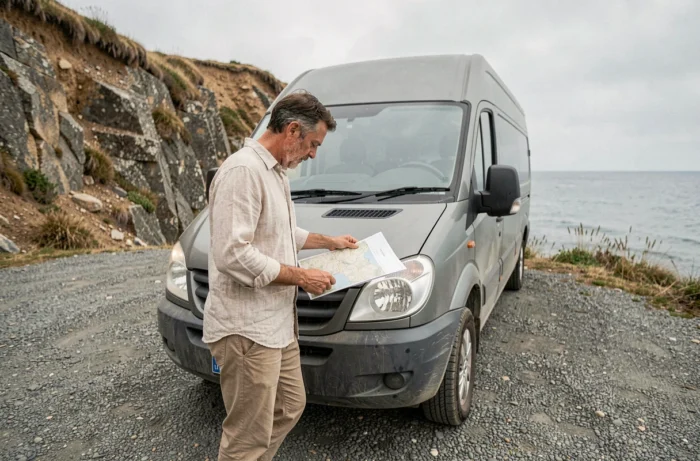
A converted van has the same parking rights as a regular car on public roads. Classified as a category M1 vehicle, it can park in any space suitable for its dimensions, including in city centers. The difficulty lies not in the right to park, but in the thin line between legal parking and prohibited camping, and in the increasing municipal regulations in tourist areas.
Night parking in a van: what local signage really changes
Most guides list places to sleep in a van. Few focus on the mechanism that transforms legal parking into an infraction. The switch does not depend on the vehicle, but on what is visible from the outside.
Deploying an awning, taking out chairs, or placing visible chocks is enough to reclassify simple parking as camping. This distinction is the main lever used by municipalities to issue fines.
Along the Breton coast, in Haute-Savoie, or in southern seaside resorts, local regulations have tightened in recent years. Some municipalities now impose specific time slots for prohibiting night parking, sometimes supported by dedicated signage. In Chamonix, for example, wild parking of motorhomes and vans is subject to stricter restrictions. Trégunc, in Brittany, has regulated night parking for vans and motorhomes in several areas.
Before choosing a parking spot for a converted van, checking the signs upon arrival remains the most reliable precaution. A specific prohibition pictogram for recreational vehicles or a time mention on the parking sign almost always indicates an active municipal order.
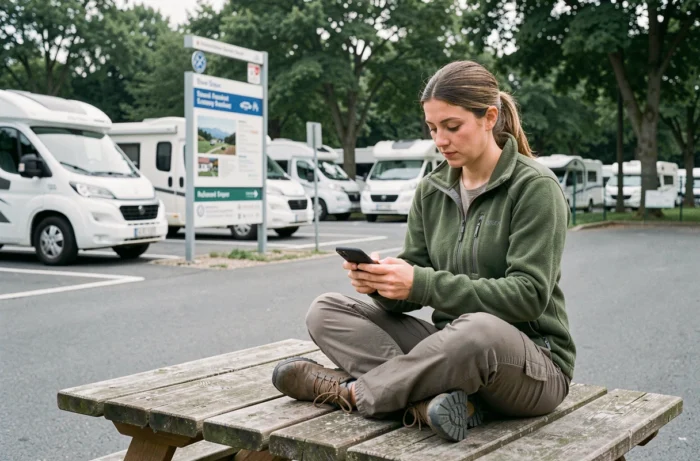
Towing of the van: the risk that vanlifers underestimate
The fixed fine grabs attention, but the towing represents the heaviest financial risk. When a vehicle is parked in a prohibited spot or the driver does not move it after being fined, the towing procedure can be initiated.
The cumulative cost (towing fees, daily storage, fine) far exceeds that of a simple ticket. For a converted van weighing several tons, towing fees are calculated based on the vehicle’s weight, which increases the bill.
Moving the van as soon as a ticket is received cuts short the escalation. Testimonials from fined vanlifers show that most problematic situations could have been avoided by moving the vehicle within hours of the first warning.
Tracking apps and regulatory layers: beyond the pretty spot
Park4Night remains the reference app for identifying spots shared by the community. Field feedback varies on the reliability of spots marked as “free” or “tolerated,” as the regulatory situation evolves from season to season.
What has changed recently is the integration of regulatory layers into these tools. Low emission zones (LEZ) alter the search for spots: an older van may be banned from circulation in certain urban areas, rendering previously identified urban spots obsolete. Checking the required Crit’Air sticker before planning a city stop avoids a double penalty (LEZ fine and parking fine).
Google Maps in satellite view allows you to spot clear areas outside the main roads. Cross-referencing this view with the regulatory information available on Park4Night or tourism office websites provides a more reliable result than using a single tool in isolation.
Concrete criteria for filtering a spot
- Presence or absence of specific prohibition signs for recreational vehicles (crossed-out motorhome pictogram, time mention)
- LEZ compatibility if the spot is located in or near a concerned urban area
- Flat and stable ground, allowing parking without visible chocks from the outside
- Reasonable distance from a water point or services (dumping, filling) to limit unnecessary movements
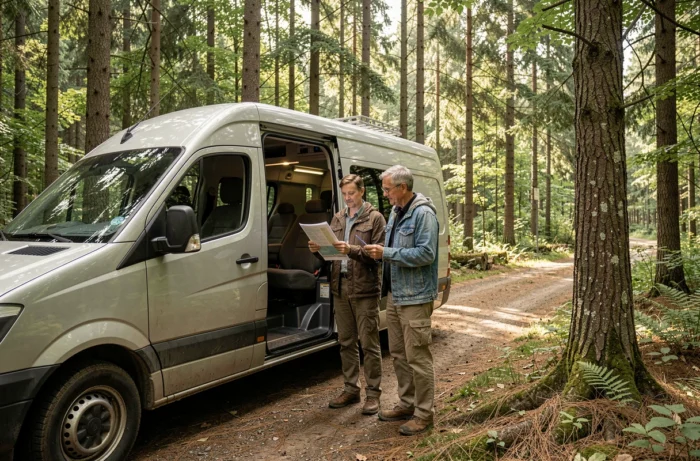
Parking rules for vans abroad: what differs in Europe
Rules vary significantly from country to country. Some European territories explicitly prohibit night parking outside dedicated zones, while others tolerate it under conditions similar to those in France.
Spain has recently clarified its regulations on parking for motorhomes and converted vehicles, specifying the criteria that distinguish a “well-parked” vehicle from one in a camping situation. In Germany and Austria, the Stellplätze network (dedicated areas) offers a structured but often paid framework.
In Scandinavian countries, the right to access nature (allemansrätten in Sweden) allows bivouacking under certain conditions, but does not automatically apply to motorized vehicles. The available data does not allow for a uniform picture across Europe: each destination requires specific verification before departure.
Points to check before crossing a border
- Local legislation on the distinction between parking/camping for converted vehicles
- Existence of dedicated areas (Stellplätze, service areas) and their potential costs
- Seasonal restrictions in natural parks or protected coastal areas
Duration of continuous parking: the often-ignored French rule
The maximum duration of continuous parking on public roads is limited in France. Beyond this period, the vehicle may be considered as an administrative wreck, which opens the door to a towing procedure by the municipality.
In practice, this limit pushes vanlifers to regularly alternate their spots. Moving the van a few streets away is not always sufficient: some municipalities apply the rule at the sector level, not at the individual space level.
Extended parking on private land follows different rules, particularly regarding urban planning. Setting up a van permanently on private land may require prior declaration, depending on the duration and nature of the occupation.
Finding a good spot for a converted van relies less on knowledge of the “best spots” than on understanding the local regulatory mechanisms. The line between tolerance and fines often hinges on a detail visible from outside the vehicle, a sign read too quickly, or a municipal order published between two seasons.