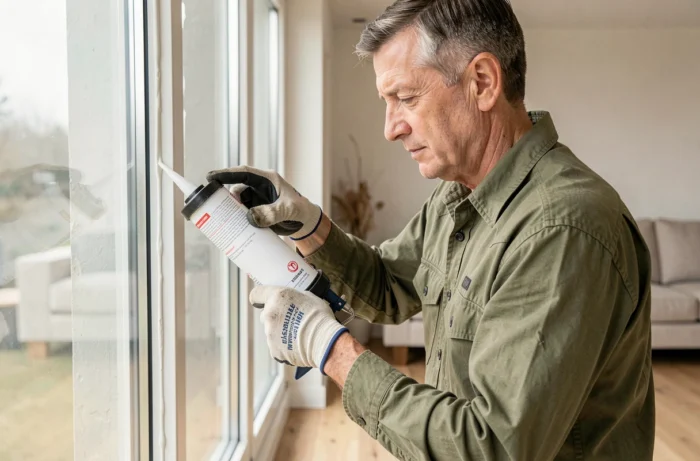
A silicone window seal is a flexible polymer cord applied between the frame of the joinery and the wall (or between the glazing and the frame) to block the passage of air and water. Its composition – neutral, acetic, or hybrid silicone – determines both its compatibility with the substrate, its durability, and its impact on indoor air quality.
VOC emissions and labeling: the criterion that product sheets do not highlight
Since January 1, 2023, the French reference value for formaldehyde in indoor air has been revised. The emission label A+/A/B/C is based on strict thresholds: class A+ corresponds to less than 10 µg/m³ of formaldehyde and less than 1,000 µg/m³ of total VOCs under test conditions.
In practice, silicone sealant applied around a window releases volatile compounds for several days after installation. In a controlled ventilation housing (simple or double flow), these emissions are more concentrated than in an old naturally ventilated building.
Checking the indoor emission label of the sealant before purchase helps avoid degrading air quality, especially in BBC renovations. The A+ mention on the cartridge is not always sufficient: cross-referencing this label with the safety data sheet allows confirmation of the product’s actual class. Some technical data sheets display a VOC content on the packaging without specifying the standardized emission class, which can be misleading.
Before choosing a silicone window seal, it is essential to distinguish between two often-confused data: the VOC content of the product in the cartridge and the concentration measured in the ambient air after application.
Neutral, acetic, or hybrid silicone: compatibility with the window frame
The type of silicone curing determines its compatibility with the frame material. Confusing the families of sealants can cause detachment, irreversible stains, or accelerated corrosion of the substrate.
Acetic silicone
This sealant releases acetic acid during drying (characteristic vinegar smell). It adheres well to glass and enamelled surfaces. Acetic silicone attacks unprotected metals and certain components of tinted PVC. Its use on raw aluminum windows or painted wood frames with a fragile finish is not recommended.
Neutral silicone
Neutral silicone is the most versatile for window sealing. Its curing does not produce acid, making it compatible with PVC, aluminum, wood, and stone. It costs slightly more than acetic silicone, but it avoids corrosion problems on metal profiles and fixing brackets.
MS polymer sealant
This hybrid product combines a modified silane polymer base with flexibility similar to silicone. It can be painted after drying, unlike pure silicone. For a wood window to be repainted, MS polymer offers a clear advantage. However, its UV resistance over the long term is still lower than that of a quality neutral silicone.
- PVC window: neutral silicone (no risk of plasticizer migration with an appropriate product)
- Aluminum window: neutral silicone, never acetic (risk of corrosion of alloys)
- Raw or painted wood window: MS polymer if the finish needs to be repainted, otherwise neutral silicone
- Glazing on frame: special neutral silicone for glazing, formulated not to migrate into laminated glass
Surface preparation and cord thickness: two frequent failure factors
A well-chosen silicone can fail if the surface for application is not properly prepared or if the thickness of the seal is inappropriate. These two parameters are more decisive than the brand of the product.
Cleaning and primer
Silicone does not adhere to a greasy, dusty, or damp surface. Before application, clean the frame and the rebate with an appropriate solvent (isopropyl alcohol for PVC, white spirit for lacquered aluminum) and let it dry completely.
On porous substrates like stone or raw concrete, a specific silicone primer improves adhesion. Without a primer, the seal gradually detaches due to thermal expansion cycles.
Thickness and backer rod
A silicone cord that is too thin (less than a few millimeters) cracks quickly under mechanical stress. A cord that is too thick dries poorly in depth and remains soft in the center for weeks.
The backer rod in polyethylene calibrates the depth of the cord. It prevents the silicone from adhering on three sides, which would create internal stresses and premature detachment. The principle is simple: the seal must stick on two opposite sides and remain free at the back.
- Completely remove the old seal with a scraper or cutter before reapplying
- Apply masking tape on both sides for a clean cord
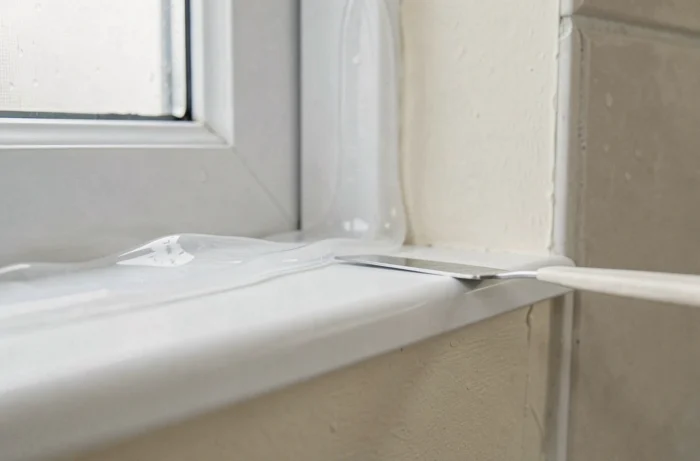
- Smooth immediately with a wet finger or spatula before skin formation (a few minutes depending on the temperature)
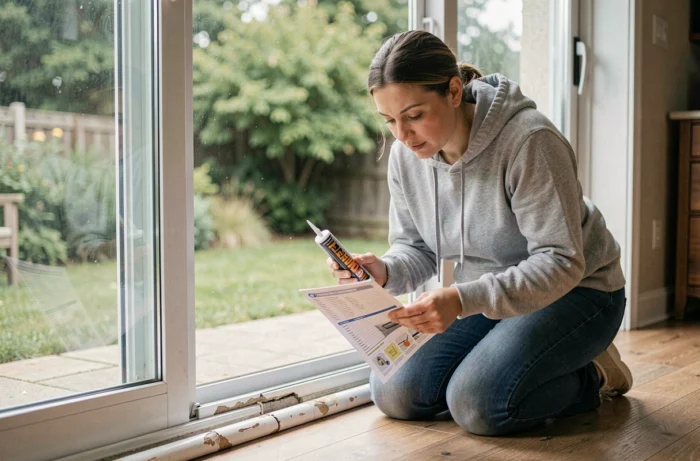
Interior or exterior sealing: adapting the silicone to exposure
The exterior seal is subjected to UV rays, temperature fluctuations, and direct runoff. The interior seal primarily manages air tightness and condensation. The requirements are not the same.
On the exterior, prioritize a neutral silicone with UV resistance explicitly mentioned on the technical data sheet. Low-quality silicones yellow and crack after a few years of direct sun exposure, which opens pathways for water infiltration.
On the interior, the priority is the emission class (A+ preferred) and compatibility with the substrate. A transparent or mass-tinted silicone integrates better visually than classic white, especially on dark joinery.
The exterior seal and the interior seal of the same window can be of different natures. Using a painted MS polymer on the interior and a high UV resistant neutral silicone on the exterior is a coherent approach on a wooden joinery.
Ultimately, the choice of a silicone window seal relies on three concrete decisions: the compatible chemical family with the frame, the appropriate emission class for the ventilation of the housing, and the preparation of the substrate before application. A sealant properly applied on a clean surface with an appropriate backer rod lasts several years without intervention.