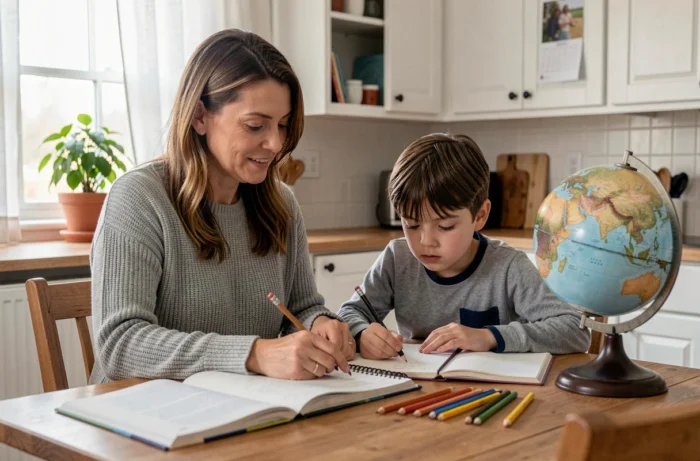
Since the start of the 2022 school year, homeschooling in France is no longer just a simple declaration. The shift to a prior authorization regime has changed the conditions for accessing home education, with an examination of the application in light of the child’s best interests. Families who choose this path face a stricter regulatory framework, annual pedagogical checks, and a daily organization that requires as much rigor as flexibility.
Authorization for homeschooling: what the legal framework requires since 2022
Before 2022, a declaration was sufficient to withdraw a child from the traditional school system. The current regime is based on four exhaustively defined reasons: the child’s health or disability, intensive sports or artistic practice, itinerancy or geographical distance, and a situation specific to the child accompanied by a detailed educational project.
Applications must be submitted within a window between March 1 and May 31 preceding the relevant school year. There are some exceptions, particularly for health reasons that arise after this period or a proven threat to the physical or moral integrity of the child in their establishment, certified by the school principal.
Authorization is generally to be renewed each year. Only health or disability cases can lead to an authorization covering up to three years. This constrained timeline requires parents to anticipate their educational project well in advance, with a reasoned application that will be evaluated by academic services.
For those who wish to delve deeper into the procedures and concrete experiences, several parents share their journeys, such as those who recount homeschooling with Maman Anonyme, detailing the administrative steps and daily adjustments.
Educational project for homeschooling: what a solid application contains
The fourth reason for authorization, the “situation specific to the child,” concerns the majority of families not falling under a medical or sports case. It requires the drafting of a detailed educational project. Academic services evaluate the coherence of this project, its ability to cover the common core of knowledge, and how parents plan to ensure the child’s progress.
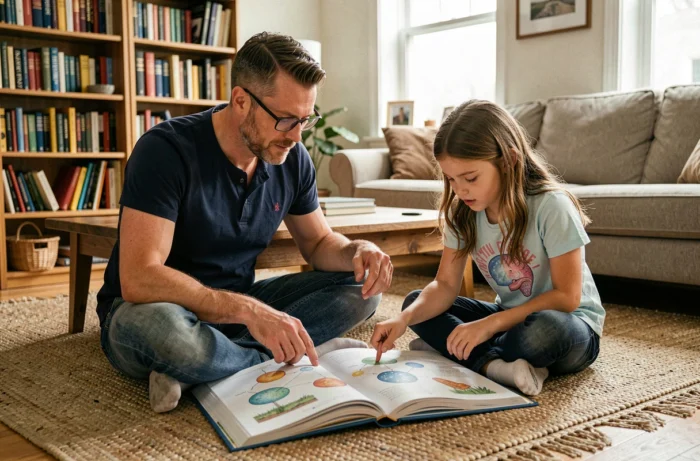
An application that merely lists textbooks or mentions a correspondence course organization is generally insufficient. Field feedback shows that accepted applications describe specific pedagogical methods, an indicative timetable, the materials used by subject, and the evaluation methods the family will implement.
Families whose application is rejected have an administrative appeal. The rejection rate varies by academy and application profiles, with no consolidated national statistics available to date.
Points checked during the annual pedagogical assessment
Once authorization is obtained, the family receives a visit from a National Education inspector each year. This assessment focuses on the child’s progress concerning the common core, not necessarily on adherence to a program identical to that of public school. Inspectors evaluate:
- The progressive mastery of reading, writing, and arithmetic, adapted to the child’s age and starting level
- The acquisition of knowledge in history-geography, science, and modern languages, even if the pedagogical approach differs from the traditional school framework
- The child’s ability to express themselves, argue, and demonstrate intellectual curiosity consistent with the objectives outlined in the educational project
- The available material environment (books, digital resources, workspace), without requiring the reproduction of a classroom
A first assessment deemed insufficient leads to a second assessment within a timeframe set by the academy. Two consecutive negative assessments may lead to a formal notice for reschooling.
Daily organization: what families adjust over the months
One of the least documented aspects of homeschooling concerns the evolution of organization over time. Most families who share their experiences describe an initial adjustment term, where schedules, pace, and methods are tested and then modified.
Some parents establish a structured timetable from the outset, with time slots allocated by subject. Others adopt a more flexible approach, grouping core subjects in the morning and exploratory activities in the afternoon. The organization that works at the start of the school year is rarely the one maintained in June.
Field feedback varies on one point: the necessity of a dedicated space. Some families set up a fixed office, while others work at the kitchen table or in various locations depending on the day. What consistently emerges from the testimonies is the regularity of work periods rather than the location.
The issue of socialization, beyond the cliché
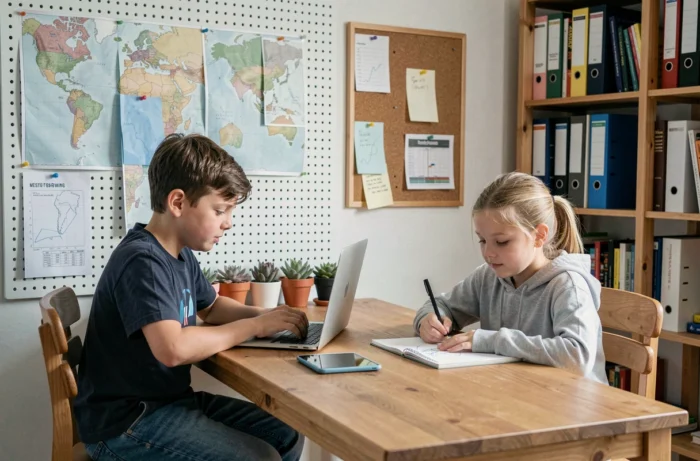
Socialization remains the most frequent objection raised against families practicing homeschooling. Concerned parents generally describe extracurricular activities (sports, music, community workshops) and regular meetings with other homeschooling families.
The reality varies greatly depending on the place of residence. In urban areas, networks of homeschooling families are denser, and accessible activities are more numerous. In rural areas, isolation can weigh more heavily, both for the child and the instructing parent. The mental load almost always rests on one parent, most often the mother, which is a factor of weariness rarely addressed in practical guides.
International rise in homeschooling after the pandemic
The phenomenon extends beyond the French context. Several countries have recorded a massive increase in homeschooling between 2019 and 2023, accelerated by the prolonged closure of schools during the pandemic.
This increase has led many families to discover homeschooling out of necessity before choosing it out of conviction. The movement is observed in countries with very different regulatory frameworks, from the United States, where regulations vary by state, to France, where the authorization regime represents one of the most regulated systems.
This trend raises questions to which educational systems have not yet provided stabilized answers: how to guarantee the quality of education without imposing a single model, and how to support families without disproportionately monitoring them. Each country makes different choices, and regulatory adjustments continue as the number of affected families increases.